

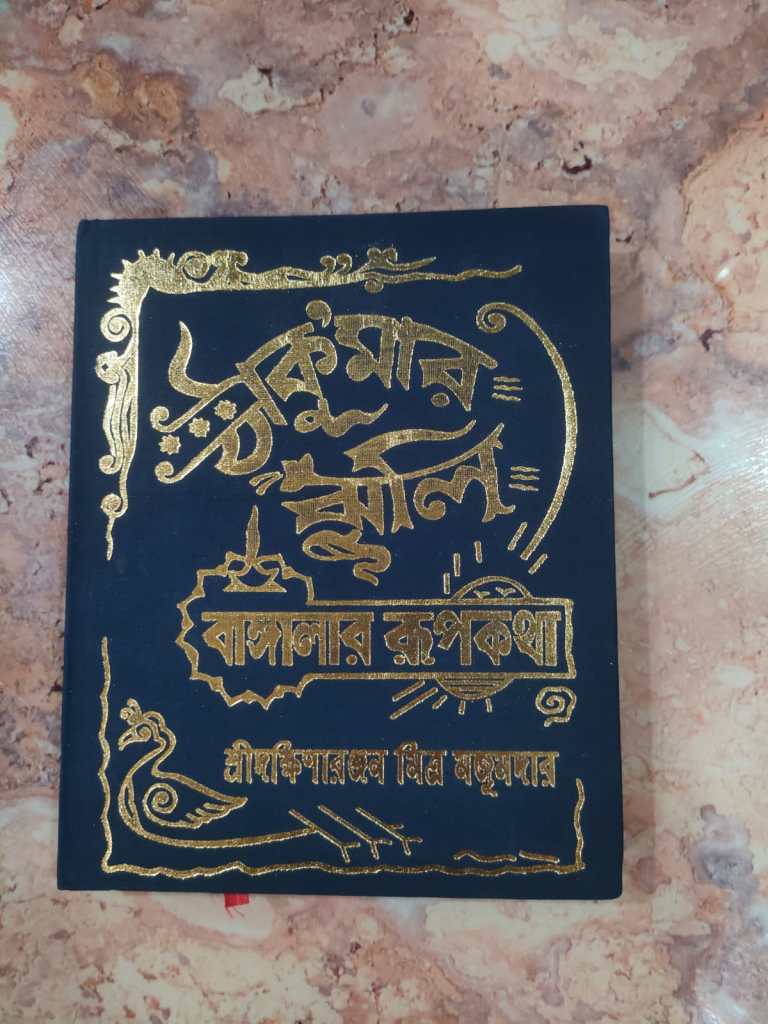
(Thakurmar Jhuli (Grandma’s Bag): The Emergence of Classical Tales)
“বাঁচার মজা গল্পে লুকিয়ে, খুঁজে পাবে ধীরে ধীরে। “
(“The joy of living hides in stories; you’ll find it, little by little.”)
In December 1903, the colonial government, in a calculated move, announced the partition of Bengal with the ultimate motive of divide and rule. The news sent shockwaves through the province and stirred resentment and widespread agitation among the masses. The air was thick with tension. The anti-partition sentiment soon aligned with the Swadeshi movement which officially began from Kolkata’s Townhall on August 7, 1905. By September 1, 1905, the partition of Bengal was formally declared by then Governor-General, Lord Curzon.
The period between 1905 (partition) and 1911 (annulment) saw the Swadeshi movement seep into every fabric of Bengali life, including its literature.
During this time, India was heavily under the influence of European fairytales and their translations. Children were increasingly introduced to Western stories and culture, a strategic attempt by the colonial government to dilute the indigenous cultural identities.
Nobel-Laureate Rabindranath Tagore articulated the dire need for Bengali folk tales that could reflect the cultural richness of oral traditions.
But did Bengal reclaim its own folklore, or did European stories dominate the narrative? Let us delve into history to uncover the truth.
The Seeds of Literary Revolution
Dakshinaranjan Mitra Majumdar was born in Ulaiil near Dhaka district on 15 April, 1877. He lost his mother when he was just 9. He was raised by his paternal aunt, Rajlakki Debi in Mymensingh, a district of Bangladesh. At the age of 21, he moved to Murshidabad with his father. Education was not his strong suit, but he confided in books and in the enchanting fairy tales narrated by his mother and aunt during his formative years. After completing his F.A. degree, he returned to his aunt to take care of her zamindari in Mymensingh.
Rajlakki Debi entrusted him to visit the villages within their jurisdiction and record local folklore.
For the next 12 years, young Dakshinaranjan tirelessly travelled to numerous villages. He carried a phonograph to record the stories recited by elders to their children. He meticulously captured the tales, songs, and even nuances of dialects and cultural expressions from boatmen, peasants, and travellers. Dakshinaranjan took up the mantle to revive Bengal’s storytelling heritage.
Unfortunately, he did not find a publisher initially. The publishers turned him down owing to the growing popularity of Western fairytales.
Undeterred, he went on to set up his press to self-publish his first book but then Dinesh Chandra Sen, Bengali writer & researcher of Bengali folklore, found the manuscript promising and hence got it published by one of the renowned publishers of the time, Bhattacharya & Sons.
He compiled the stories in Matrigranthabali- a series of four volumes of authentic folklore collections:
- Thakurmar Jhuli (1907)
- Thakurdadar Jhuli (1909)
- Thandidir Thale (1909)
- Dadamashayer Thale (1913)
Thus, Thakurmar Jhuli: Banglar Roopkatha (Grandmother’s Bag: The Fairy Tales of Bengal), the inaugural volume, was born in 1907.
The indigenous stories struck a chord immediately and 3000 copies were sold within the first week.
The anthology, Thakurmar Jhuli, features fourteen stories, divided into three sections and a fourth section with 3 poems:
- Dudher Sagor (Sea of Milk): Tales of adventure.
- Rooptarashi (Scary Form): Tales of Demons
- Chyang Byang (Fish-Frog): Animals & Humorous Tales
- Aam Sandesh (Mangoes and Sweets): Poems reciting the ritual of putting children to sleep.
The book is the most acclaimed anthology of Bengali fairytales. It has earned epithets like “an epoch in Bengali literature”, “the public book”, “Bengal’s eternal flute”, “a people’s identity” and “a Nation’s attractions” by eminent nationalists and intellectuals like Surendranath Banerjee, Aurobindo Ghosh, Chittaranjan Das, Rabindranath Tagore and Rameshchandra Dutt.
Rabindranath Tagore’s introductory essay adds unparalleled charm to the book.
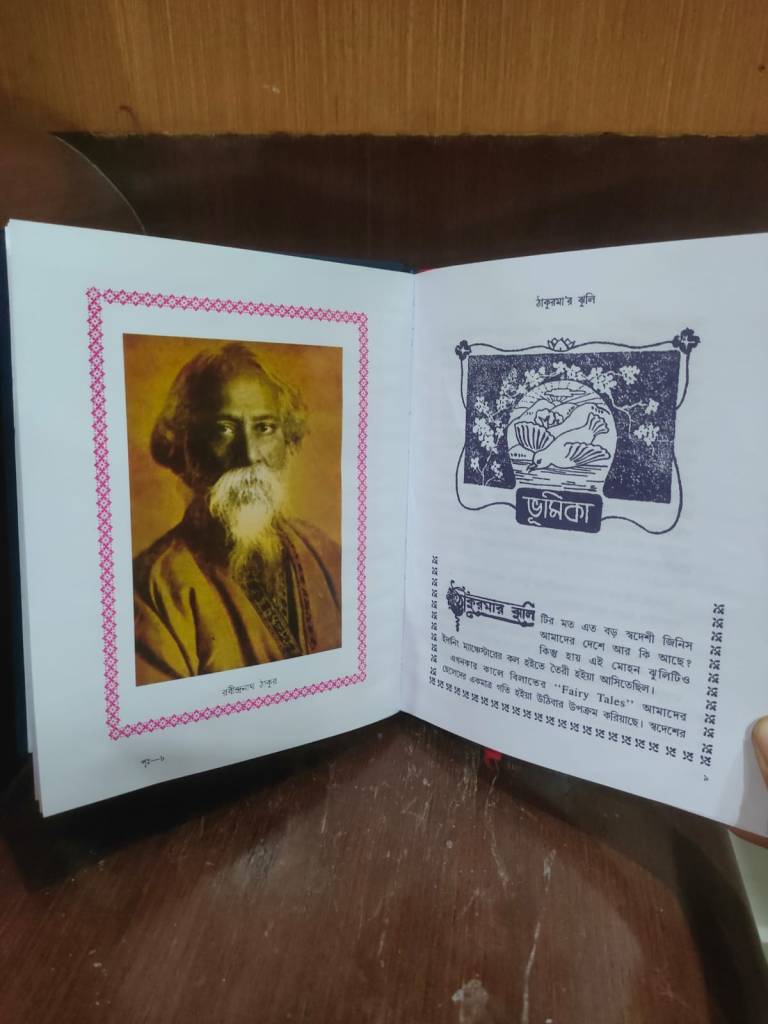
রবীন্দ্রনাথ ঠাকুরের ভূমিকা থেকে উদ্ধৃত এই অংশটি:
“ঠাকুরমার ঝুলিটার মত এত বড় স্বদেশী জিনিস আমাদের দেশে আর কি আছে? কিন্তু হায়, এই মহান ঝুলিটাও ইদানীং ম্যানচেস্টারের কল হতে তৈরী হইয়া আসিতেছিল।”
এখানে তিনি দুঃখ প্রকাশ করেছেন যে, বিদেশী রূপকথার প্রভাবে আমাদের নিজস্ব লোককথাগুলো অবহেলিত হচ্ছিল।
তাঁর মতে, “ঠাকুরমার ঝুলি” আমাদের স্বদেশী সংস্কৃতি ও ঐতিহ্যের প্রতিফলন, যা আমাদের শিশুদের জন্য অত্যন্ত মূল্যবান।
এই ভূমিকার মাধ্যমে রবীন্দ্রনাথ ঠাকুর আমাদের নিজস্ব লোককথা ও সংস্কৃতির সংরক্ষণ ও প্রচারের গুরুত্বকে জোর দিয়েছেন।
Translation:
A few lines from Rabindranath Tagore’s introduction to Thakurmar Jhuli:
“In our country, could there indeed be anything quite as swadeshi as this Thakurmar Jhuli? But alas! Nowadays even this wonderful bag was being sent to us manufactured from the factories in Manchester.
These days, the English ‘Fairy Tales’ are increasingly taking over as the only refuge of our children.
He underscores the importance of preserving and cherishing these native stories, as they are deeply rooted in the nation’s heritage and play a crucial role in shaping the minds and imaginations of young Bengalis.
A need for cultural identity to bind the people during partition gave birth to ‘Thakurmar Jhuli’ which became an iconic book passed down to generations. The stories of Kings, Queens and Demons are enjoyed by young and adults alike.
While the stories themselves are ancient and passed down through oral traditions, they reflect progressive ideas, particularly regarding feminism.
Assistant Professor Debosmita Paul, has provided detailed insights into the stories, emphasizing their strong female characters. The wit, bravery, and resilience of these female protagonists, including formidable female demons, symbolize empowerment in an era of vulnerability.
Such stories, when shared with young minds, foster a generation of dreamers and believers in equality and empowerment.
For instance, stories like “Lalkamal Neelkamal” and “Buddhu Bhutum” depict characters who navigate challenges with resilience and intelligence, imparting lessons of hope and perseverance.
This “timeless blue book” holds a special place in Bengali households. It reminds the carefree days of childhood. It celebrates the beauty of stories and the importance of storytelling that probably every Bengali home has witnessed. Thakumar Jhuli is not just literature; it is a legacy. A legacy that echoes the golden thread of storytelling binding together the past, present, and future of Bengal.
References:
- https://www.indianculture.gov.in/digital-district-repository/district-repository/thakurmar-jhuli-dakshinaranjan-mitra-majumdar
- https://www.jstor.org/stable/44478647
- https://en.wikipedia.org/wiki/Dakshinaranjan_Mitra_Majumder
- http://bengalichildrensbooks.in/ThakurmarJhuli.php
- https://www.deshbandhucollege.ac.in/pdf/resources/1587611963_H(H)-VI-The_Swadeshi_movement.pdf
PS1: This post is a part of ‘Embrace the Native Blog Hop’ hosted by Manali Desai and Sukaina Majeed under #EveryConversationMatters” to celebrate “International Mother Language Day” on 21st February 2025.
PS2: This blog post is part of ‘Blogaberry Dazzle’
hosted by Cindy D’Silva and Noor Anand Chawla.
 Cerebration
I have only heard of greatness of Bengali literature and music but your post actually gives a glimpse into what it exactly was. Thanks for penning this down.
LikeLiked by 1 person
Thank you for your kind words! I am grateful for this incredible topic that gave me an opportunity to curate this post, and I’m equally glad to know it could offer a glimpse into the beauty and legacy of Bengali literature.
LikeLike
The way Thakurmar Jhuli emerged as a cultural cornerstone during a turbulent time in Bengal’s history is truly inspiring.
LikeLiked by 1 person
Thank you for reading! I am glad you liked it 💖
LikeLiked by 1 person
I’m hearing of this for the first time. 3000 copies sold in a week is quite a record in those days. The introduction by Tagore throws additional light into the greatness of the work.
LikeLiked by 1 person
You are absolutely right. Selling 3,000 copies in the first week back then is truly remarkable! Thakurmar Jhuli holds an important piece of history, yet it has sadly faded from the spotlight and remains unknown to many today. Thanks for sharing your thoughts!
LikeLike
I’ve been an avid Rabindranath Tagore fan and he is perhaps my introduction to Bengali literature and books. Reading about Dakshinaranjan Mitra Majumdar and his works has surely enlightened me furthur about Bengali literature and authors.
LikeLiked by 1 person
Thank you so much. Glad you liked it ❤️
LikeLike
3000 copies sold in a few days? that’s incredible for those early days when most people were illiterate. Apart from a few works of Rabindranath Tagore, my knowledge in Bengali literature is nil… although these days I do read translations of modern day authors. It was interesting to read about Dakshinaranjan Mitra’s story and how he became a writer and his influence on Bengali literature.
LikeLiked by 1 person
Yes the history baffled me too and that’s when I decided to bring it to light. Glad you liked the post 💖
LikeLiked by 1 person
Yes history baffles us sometimes. Thanks for reading ❤️
LikeLiked by 1 person
This is so great! Indeed languages help preserve the culture of any society.
LikeLiked by 1 person
Thank you 😊
LikeLike
The history of Thakurmar Jhuli is inspiring. I know about RavindraNath Tagore’s book very little bit really surprised that 3000 copies sold in week. Incredible! I would like to read now these blue books.
LikeLiked by 1 person
Sure… the stories are going to transport you to childhood days. Thanks for reading ❤️
LikeLike
We sure have a rich heritage of folk tales that were narrated by our grandparents. It is commendable that Tagore penned them and made them immortal.This is an indication for me to try to read these, being a big fan of Rabindranath Tagore.
LikeLiked by 1 person
Thank you!
LikeLike
This was such an interesting read! I had never heard of Thakurmar Jhuli before, but now I’m curious to explore these timeless stories. Loved the way you highlighted its cultural significance!
LikeLiked by 1 person
Yes, books like Thakurmar Jhuli are slowly fading away but perhaps the fascinating history behind it may help in reviving its charm. Thanks for reading! ❤️
LikeLike
Wow that is a lot to be sold in just a few days! I sometimes wish I could read in other languages to get the real feel of the originality of the stories or poems. But alas!
LikeLiked by 1 person
Yes i completely resonate with you. The beauty and emotions of a story truly comes alive when told in the vernacular. May be through blog challenges we may get to read in native more!
LikeLike
I have had a glimpse of Tagore’s works during my school days and I have always held his writings as an inspiration to go by. No doubt Bengali literature have always been in the forefront ever since.
LikeLiked by 1 person
Good to know that bengali literature has touched you! Thank you for reading and sharing your thoughts.
LikeLike
I love fairy tales in all languages. But that’s some real task, travelling from village to village to keep the folklores alive. Hats off to Dakshinaranjan Mitra Majumdar! It’s so heartening to know that this blue book of Bengali fairytales sold 3,000 copies and is still alive.
LikeLiked by 1 person
Yes indeed! Such fascinating history helps to keep the charm of the book alive!
LikeLiked by 1 person
Thank you for sharing such an insightful gem of Bengali folk literature. Amazing, to what lengths people used to go to preserve our folklore.
LikeLiked by 1 person
I am glad that you liked the post. Thank you for stopping by!
LikeLike
It is surreal, and an inspirational story for self published author because it concludes at the end what matters is the impact an author creates
LikeLiked by 1 person
Yes truly! Thanks for sharing your thoughts ❤️
LikeLike
Having grown up in Bengal, I’m surprised I know only about the Geetobidhan and not Thakurmaar Jhuli. This seems like a treasure trove of wonderful tales. Is a translation available now?
LikeLiked by 1 person
Hi, yes there is an english translation available on amazon. (https://amzn.in/d/7L2tOCT). Happy reading 😊
LikeLike
Its recently only that I am digging up old books and trying to make a collection from different languages. Thanks for sharing your thoughts!
LikeLike
Thakumar Jhuli and Thakurdar Jhuli are the 2 books which I still rememeber my father bought me from the Durgapur Book Fair. I used to read that in the afternoon after returning from school and honestly after reading your post I am feeling nostalgic. I want my son to read it too but being in North India we first need to priotize Hindi as his language for easy communication but me and my husband speak with him in Bengali. So He is now in BenHindlish phase. Once he grow little more big I will buy him these precious books of Bengali literature. Nijer Bhasa Matri Bhasa… Nijeder bhasar Sahitto jana khub darkar. Thank you Pinky for this wonderful post.
LikeLiked by 1 person
Thank you for sharing such a heartfelt memory! It’s wonderful to connect with someone who cherishes Thakurmar Jhuli and Thakurdar Jhuli. Hats off to your efforts in teaching your son Bengali while balancing Hindi. Nijer bhasa sikhte pawar moja-i alada. I’m sure he’ll treasure these stories too once he is ready!
LikeLike
I’m really surprised to learn that 3000 copies were sold in just one week – incredible. It’s impressive how these stories continue to make such an impact even today. I hadn’t heard of Thakurmar Jhuli before, but now I’m eager to explore these timeless tales. Thanks for sharing.
LikeLiked by 1 person
I’m delighted that the post sparked your curiosity about these stories. Thank you for taking the time to visit!
LikeLike
Now once again I am torn because I can’t read the original work. I would like to see if the translation of these are available. No doubt the translation will lose the nuances of dialects, and cultural expressions of various comunites of the society. But atleast I will read the stories.
LikeLiked by 1 person
Yes the English translation is available but rightly said, it might lack those cultural nuances. But great that you are attempting to know these stories. I am so glad! Thank you
LikeLiked by 1 person
I am tooo much fascinated by two other cultures in India in particular after my own. Bangali and Kannad
LikeLiked by 1 person
Ah that’s wonderful. Here I am grappling to keep my native language alive in my heart and soul and your curiosity towards other languages is commendable. I am now thinking to take up some translation works too. Thanks for the motivation 😊
LikeLiked by 1 person
Please do. And I would urge you to think of some other Indian languages to translate it into. Instead of English. If not us, who else will.
LikeLiked by 1 person
Yes great suggestion. Thank you so much😊
LikeLiked by 1 person
Whoa! Now this is a piece of history that needs to be revived and revived robustly! I’m so grateful to you, Pinkii, for introducing me to Dakshinaranjan Mitra Majumdar, whom I had no clue of! I’m going to look for this fabulous collection and hopefully I should be able to find an English translation! One of the best posts of this week, for me at least.
LikeLiked by 1 person
Thank you so much for such words! Yes there are english translations available on amazon. Haven’t read but i guess it’s worth checking them out! ❤️
LikeLike
Folktales like these aren’t just stories; they’re a connection to our roots, traditions, and childhood memories
LikeLiked by 1 person
Indeed! Thank you for stopping by and sharing your thoughts.
LikeLiked by 1 person
I am so glad that I get to learn so many new aspects. Thank you for bringing this to me. This is such an interesting and informative post.
LikeLiked by 1 person
Thank you for your kind words. I’m glad you found the post so interesting! ❤️
LikeLike
Regional literature is often seeped in culture and heavily fakes inspiration from real lives and stories. Bengali literature is one of the richest in our country and now we know why. Great to know about this gem. Maybe I can find a translation somewhere?
LikeLike
takes*
LikeLiked by 1 person
Thank you! Yes there is an English translation available on amazon but I haven’t read that. May be it’s worth checking out- https://www.amazon.in/Thakurmar-Jhuli-Princesses-Creatures-Dakshinaranjan/dp/8195212700?dplnkId=4047d5b4-8875-45f0-b0a3-bdbab736b05f
LikeLike
Fairy Tales have always fascinated readers. It is wonderful to hear how Dakshinaranjan Mitra Majumdar travelled from village to village with a phonograph, capturing stories to revive Bengal’s storytelling culture. What a wonderful slice of Bengali literature!
LikeLiked by 1 person
Thank you so much. Glad you liked the post l!
LikeLike
Thank you for sharing about this great gem in literature. I am on the lookout for Indian translated works and I will surely add this to the list.
LikeLiked by 1 person
Glad to hear!!! Thank you
LikeLike
This was such a fascinating read! The historical and cultural significance of Thakurmar Jhuli is truly remarkable, especially in the context of the Swadeshi movement and the need for preserving indigenous storytelling. Thakurmar Jhuli isn’t just a collection of tales; it’s a cherished legacy that continues to inspire generations. Thank you for this beautifully written and informative piece
LikeLiked by 1 person
It is a legacy indeed! Thank you so much. Glad you found the post interesting!
LikeLike
I am in awe of how much labour and perseverance has gone into preserving such valuable tales which otherwise would have been lost in time! Thank you for such an insightful post .
LikeLiked by 1 person
Glad you liked the post! Thank you for sharing your thoughts on the piece!
LikeLiked by 1 person
Thakurmar Jhuli, 3000 copies sold— It’s really wonderful to learn about. Both as a reader and writer, I comprehend how some words/literary pieces can cast an everlasting impression on one’s mind, and Thakurmar Jhuli is one of the best examples. Great write-up.
LikeLiked by 1 person
Thank you so much! Glad you liked the post!
LikeLike
Just reading Tagore’s introduction to the book makes me want to pick it up. As you said, it is not literature but a legacy. All the more need to preserve them. Thanks for sharing about the book.
LikeLiked by 1 person
True! Tagore’s introduction felt so honest and heartfelt. Thank you for reading the post ❤️
LikeLike
This seems to be a good literary work. I’ve only heard of its richness. Glad that I came across this post
LikeLiked by 1 person
Thank you so much ❤️
LikeLike
I am pleased to hear the Bengali rich literature. To arouse awareness for their own folktales and culture, many authors and poets worked hard and attained success. It us huge success in those times. I appreciate your research and efforts to bring this in limelight.
LikeLiked by 1 person
Thank you so much. Your kind words are encouraging ❤️
LikeLike
You know it’s the mark of an in-depth, well-researched, and authentic post when it mentions the references. I would also like to thank you for adding ‘to celebrate “International Mother Language Day” on 21st February 2025.’ at the end of the mandatory line. Thanks for introducing me to this book. I’m checking if a translated version is available on Amazon or somewhere else coz this seems like a necessary read to understand and appreciate Bengali literature, and also to get inspired coz it has strong women characters.
LikeLiked by 1 person
Thank you so much for such kind words! Comments like this actually motivate you to write more write better. And yes translated versions are available on amazon 👍
LikeLike
Wow. It’s essays like these that make us contemplate of the influence of the european culture and how some communities have sucessfully preserved theie culture. Something worth reading.
LikeLiked by 1 person
Thank you for such kind words. Means a lot ❤️
LikeLike
I didn’t know this at all… Delighted to read about it!
LikeLiked by 1 person
Thank you!
LikeLiked by 1 person