

There was a soft knock on the door.
Tumpa hurriedly left the kitchen to check.
“Mitali Di, you’re home early! Everything alright?” she asked, her concern evident.
“Hmmm,” Mitali mumbled, avoiding eye contact as she slipped into her room.
Tumpa hesitated for a moment but decided not to pry. She sighed and returned to the kitchen where her posto (poppy seed) curry was bubbling on the stove.
Mitali shut the door quietly and leaned against it. The weight of the day pressed down on her. Another rejection. After all those nights spent working late, sacrificing weekends, and trying her best to avoid office politics, the promotion had gone to someone who excelled at playing the game.
Mitali clenched her fists. Frustration swelled within her, a wave she couldn’t control. She glanced around the room and, almost by instinct, started pulling clothes out of her wardrobe. Cleaning always helped her regain focus. It was her way of channeling anger when everything felt out of control.
As she yanked at a scarf, a book tumbled out from a forgotten corner and landed on the floor with a dull thud. She paused, her irritation giving way to curiosity.
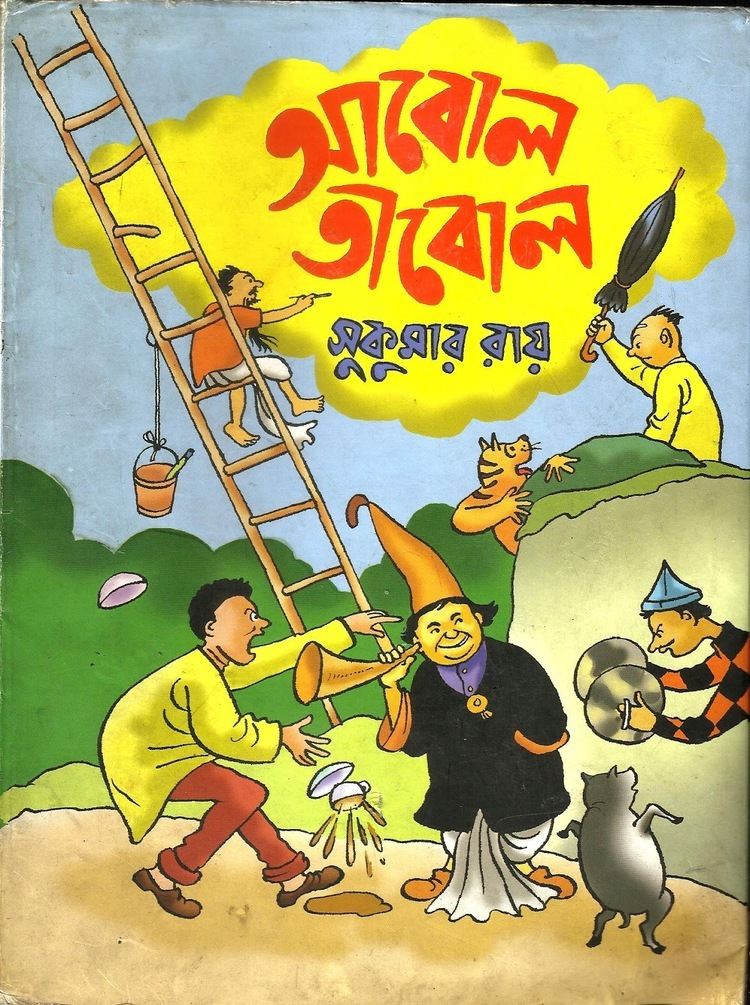
When she picked it up, her breath hitched. The cover was worn, but the bold title stood out: Abol Tabol by Sukumar Ray. A smile tugged at her lips. The nonsense rhymes that had been her childhood delight.
She flipped it open. On the first page, her mother’s familiar handwriting stared back at her:
“যদি হাল ছেড়ে দাও, গল্পের রং হারিয়ে যাবে।
তোমার মাঝেই আছে নতুন অধ্যায়ের শুরু।”
(“If you give up, the colors of stories will fade.
The start of a new chapter lies within you.”)
Her throat tightened as she read the line aloud. She could almost hear her mother’s voice, calm and comforting. The memories rushed in.
“Ma! Ma!” Little Mitali had burst through the gate, her cheeks streaked with tears.
“What’s wrong, Mana?” her mother had asked, crouching down to wipe her face.
“The teacher punished me today! She thought I was cheating just because I gave Riya a pen. She took our papers, and I couldn’t finish my answers. I’ll fail!” Mitali sobbed, barely managing to explain.
Her mother had smiled gently and hugged her. “Mana, sometimes mistakes teach us more than anything else. Next time, if someone needs help, let the teacher know. Rules are there for a reason, okay?”
Little Mitali was confused but then everything felt better in her mother’s embrace.
“Come, let’s go inside. I’ve made your favorite Begun Bhaja (fried brinjal),” her mother said, bringing a smile to little Mitali’s face.
That evening, her mother had pulled out a book with a colorful cover.
“What’s this, Ma?” Mitali had asked, curiosity replacing her tears.
“It’s Abol Tabol by Sukumar Ray,” her mother had said with a smile. “A collection of nonsense rhymes.”
Her mother had started with the first poem, its rhythm so catchy that little Mitali couldn’t help but giggle. “Another one, Ma, please!” she’d begged after the first rhyme ended. Her mother had laughed and read her another, and another, until Mitali’s eyelids grew heavy, and she drifted off into a world of talking animals and absurd adventures.
A faint giggle outside her room brought Mitali back to the present. The sound grew louder, followed by hurried footsteps.
The door flung open.
“Ma! Look at this!”
Mitali barely had time to close the book before Bani, her 10-year-old daughter, burst into the room, her math paper fluttering in her hand, her excitement filling the space.
“I got 100 out of 100 in math today!” Bani announced, her face glowing.
Mitali’s face lit up. “That’s amazing, Beta! We should celebrate. How about baked roshogolla for dessert?”
“Yay!” Bani beamed, then noticed the book in her mother’s hands. “What’s that, Ma?”
Mitali smiled. “It’s called Abol Tabol. It’s full of magical nonsense rhymes written by Sukumar Ray.”
“Nonsense rhymes?” Bani’s eyes widened. “Does that mean they don’t make sense?”
“Not exactly,” Mitali explained. “They’re silly and fun, but they’re also very clever. Sukumar Ray wrote them in such a way that they seem like just jokes, but he was actually talking about very serious things.”
“Like what?”
“Like how people were struggling under British rule,” Mitali said. “At that time, it wasn’t safe to talk openly about these things, so he used humor and nonsense to hide those ideas in his rhymes.”
Bani tilted her head, thinking hard. “So it’s like hiding treasure in a game?”
“Exactly!” Mitali said, laughing. “He made people laugh, but he also made them think.”
“Wow, Ma! Let’s read one tonight!”
“Of course, Beta.”
Bani took the book and placed it carefully on her bookshelf, right next to her English books. Mitali noticed the quiet gesture and smiled. It was as if Bani was saying, “this deserves a place here too.“
That night, Mitali read Ha-Ja-Ba-Ra-La to Bani, the whimsical tale of a boy who finds himself in a nonsensical world. Bani giggled at the talking animals and the absurd twists, asking questions about every rhyme and story.
As Bani’s questions grew quieter and her breathing slower, Mitali closed the book and leaned back. Nonsense rhymes weren’t just silly poems; they were a way to preserve culture, to pass down wisdom, and to make people laugh even in tough times.
Her mother had been right—’ If you give up, the colours of stories will fade.’ Now, Mitali understood how these stories not only kept the colours alive but also made her worries fade into the background.”
PS: This blog post is part of ‘Blogaberry Dazzle’
hosted by Cindy D’Silva and Noor Anand Chawla.
 Cerebration
Nicely written 👍
LikeLiked by 1 person
Thank you 😊
LikeLike
What a nice way to give us a book review too.
Inspiring messages hidden in nonsensical rhymes is avery unique way to reach out to the reader.
Sukumar Ray was truly gifted.
LikeLiked by 1 person
Indeed he was! What a clever way to write. Thank you for stopping by and sharing your thoughts
LikeLike
This was such a beautiful read! I love how stories connect generations, carrying wisdom in the simplest ways. That last line hit deep, truly, stories keep the colors of life from fading.
LikeLiked by 1 person
Thank you ❤️ trully grateful the story could strike a chord and leave an impact.
LikeLike
This piece felt so nostalgic and deeply emotional—I could almost see the fading stories come alive as I read. The way you captured the essence of memories slipping away was beautifully poignant. It made me reflect on how so much gets lost with time, yet some fragments always linger in unexpected ways.
LikeLiked by 1 person
Yes true, these fragments are worth holding onto. Thanks for sharing your thoughts on this!
LikeLiked by 1 person
Endless wisdom. What a nice gift from a mother to a daughter and the beautiful book that has stood the test of time. This is a good story.
LikeLiked by 1 person
Thank you so much!
LikeLike
Such a heartwarming tale.There is innate wisdom lying in our folklore which we should keep alive for our coming generations. people are losing touch with reality with the virtual world becoming omnipresent.
LikeLiked by 1 person
Absolutely!! I couldn’t agree with you more. Thanks for taking the time to read and share your thoughts
LikeLike
Having grown up in Kolkata, I’ve heard so much about abol tabol. But since I can’t read Bengali, I’ve never read it. You’ve woven this into a beautiful story of never giving one that is passed down from a mother to her daughter and then to the next generation. That’s the purpose of a story, right?
LikeLiked by 1 person
Absolutely! I think stories and books are also a valuable asset that we need to pass to the next generation, something that will anchor them to their roots from the beginning. I miss these stories so much abol tabol, gopal bhad etc 😅😀
LikeLike
That’s sucha cute story! One of my good friends is nagging me to get my hands on Abol Tabol as soon as I learn the language. She has translated, as in explained a few of those non-sense rhymes, as she recited them.
LikeLiked by 1 person
Thank you so much.. yes I agree with her, you should read the rhymes, read the translation until you learn the language but the fun is reciting them in Bengali. If you look at the surface you will have a good laugh reading them and if you dive deep and analyze, they are actually commentaries on colonial india.
LikeLiked by 1 person
I looked up Abol Tabol after I read your lovely story (May such mother-daughter tribes increase and spread love), and I was gobsmacked by the first one (it said translated by Satyajit Ray), The King of Bombaria. I can see how Sukumar Ray used humour to speak about atrocities of the day! Brilliant! Thank you for introducing this amazing collection to me!
LikeLiked by 1 person
Yes, there are four translations available so far, including one by the renowned Satyajit Ray. I truly appreciate you taking the time and effort to explore Abol Tabol. It means so much to me! The stories are indeed funny, light-hearted, and cleverly crafted. Thank you for sharing your thoughts—it really means a lot!
LikeLike
What a wonderful way to present a book review. The way meaningful lessons are woven into playful rhymes is such a creative and engaging method to reach readers. You’ve made me pause and think about how stories, even the faded ones, shape us and carry us forward. Our folklore holds timeless lessons that should be preserved for the generations to come.
LikeLiked by 1 person
Yes, indeed! These are the treasures we hold close to our hearts. Thank you so much for sharing your thoughts!
LikeLike
I value, I respect and I love my Matribhasa. Ei bhasai ja madhu ache ta anno bhasai kujhe pai na. Sukumar Ray Abol Tabol amio porechi amar choto belai. Ki bhaloi na lagto. Prathame bujhtam na, tar por baba maza kore bojhato… ki je bhalo lagto. Kothai hariye geche chotobelar sei amrito din gulo. Tomai anek anek bhalobasa Bangla Sahityer katha lekhar janno. Bhalo Theko
LikeLiked by 1 person
Thank you so much for such a heartfelt comment—it truly touched me. Sotti, sei chhotobelar din gulo fire pele koto bhalo hoto—those innocent and carefree days! Banglar moto mishti bhasa ar kichu nei, ei bhasay kichu lekha amar jonno ekta gorber bishoy. Thank you for recognizing my efforts—your comment literally brought tears to my eyes. Dhonnobad! Tumi’o bhalo theko.
LikeLike
What a heartfelt tale of literature/arts connecting generations. This could’ve also made another lovely entry for Embrace the Native Blog Hop. Alas! Only one entry per blogger. But I loved it nonetheless and if our theme was responsible for inspiring this story, I’m very happy 🙂
LikeLiked by 1 person
Indeed, it was! In fact, this was the first post I curated for the theme, but I eventually decided to go with the other one. However, this story felt like a baby to me, so I couldn’t resist posting it. Embrace the Native blog hop has enriched my understanding and connection to Bengali literature, and I’m truly grateful for the experience.
LikeLiked by 1 person
Reading “The Fading Stories” deeply resonated with me. Mitali’s rediscovery of ‘Abol Tabol’ amidst personal turmoil beautifully illustrates how childhood memories and parental wisdom can guide us through challenging times. The intergenerational bond highlighted through Mitali and Bani’s shared love for literature serves as a poignant reminder of the enduring power of stories to connect and heal. This narrative evokes a profound sense of nostalgia, emphasizing the importance of preserving and passing down cultural treasures. A truly touching read that inspires reflection on our own cherished memories and the legacy we wish to leave.
LikeLiked by 1 person
I am so glad the post resonated with you. Thank you so much for sharing your thoughts here!
LikeLike
This has so many parallels with their generation and ours. Although decades apart, we face the same struggles and are calmed by the same things too. Lot to learn and pass on to our offsprings.
LikeLiked by 1 person
A beautiful read. There is always a connection and wisdom in our folk tales. Nonsensical rhymes give sensible message. Love the way you put it in story.
LikeLike
Inspiring messages in a fun way. This indeed is a legacy that needs to be passed on !
LikeLike
Oh this is so heartwarming. I loved how it speaks to all generations and a great way to share a review of a book too! Love it.
LikeLiked by 1 person
Thank you so much!
LikeLike
Growing up, Abol Tabol was an internal part of my life. First my mom used to read to me, and then I learnt reading them myself. I need to start reading these to my kiddos! These stories can’t fade!
LikeLiked by 1 person
You actually brought my story to life. I hope your kids love the stories like we did. Thanks for sharing your thoughts here!
LikeLike
Lovely story. Poignant message.
LikeLiked by 1 person
Thank you!
LikeLike
oh this was a wonderful story. I enjoyed the emotions that is behind the characters. Thanks for sharing this
LikeLiked by 1 person
I am glad you liked the story. Thank you!
LikeLike
What a beautiful and nostalgic prose! I liked your indirect way of sharing life lessons with poems and rhymes. loved it!
LikeLike
A lovely story. I should look out for Abol Tabol too.
LikeLiked by 1 person
Thank you so much! I hope you enjoy reading the book.
LikeLiked by 1 person