

The story dates back to 1970, when India was a strange mix of unity and division. The rich diversity of cultures and languages made the country so unique. But on the other hand, there were these silent but strong walls between different communities. One of those divides was between Bengalis and Oriyas.
Now, to outsiders, this might not seem like a big deal. Aren’t they both from the eastern part of India? Aren’t they neighbors? But no, for Bengalis, with their love for Tagore’s poetry and kosha mangsho (spicy mutton curry), and Oriyas, proud of their Jagannath Temple and pakhala bhata (fermented rice), the differences felt very real.
The Ghosh family learned this the hard way. Mr. Ghosh, a Travelling Ticket Examiner (TTE) with the Indian Railways, was comfortably stationed in Howrah, West Bengal—until a transfer order arrived. He had to leave behind the familiarity of Kolkata and relocate to Khurda Road in Orissa, bringing along his wife and their 9-year-old daughter, Meena. It wasn’t just a change of location. It felt like they had been uprooted from their very identity.
Kolkata was home, and what a home it was! The trams rattling down College Street, the quiet dignity of the Howrah Bridge, the intellectual arguments over cups of steaming cha—all of it was part of their rhythm. Moving to Khurda Road felt like being torn away.
When their train rolled into the Khurda Road Railway Station, the first thing they noticed was the smell of the earth—different, not bad, just… unfamiliar. The station was small, bustling, and noisy in a way that didn’t feel like Kolkata’s chaos. Mr. Ghosh was allotted a small government quarter, which was surrounded by fields instead of the noisy streets they were used to.
The neighbors were already curious. Some smiled, some stared, and a few whispered to each other, already calling them the “new Bengali family.” Meena, the youngest Ghosh, felt their eyes follow her as she clutched her favorite doll and peeked shyly at the children playing outside.
Her mother, on the other hand, was trying hard to keep her cool. She had spent the last few days planning how to set up her kitchen in this unfamiliar place. And then came the first disaster—macher jhol. The fish was wrong, the spices didn’t taste the same, and by the end of the meal, the whole family sat in gloomy silence, missing the flavors of Kolkata.
Mr. Ghosh wasn’t faring much better. His attempts at chatting with the neighbors were met with smiles, nods, and conversations that quickly switched to Oriya, leaving him feeling awkward and out of place.
Meena? She was confused. The kids outside looked friendly enough, but they spoke too fast, laughed at jokes she didn’t understand, and played games she didn’t know. Meena felt like an outsider.
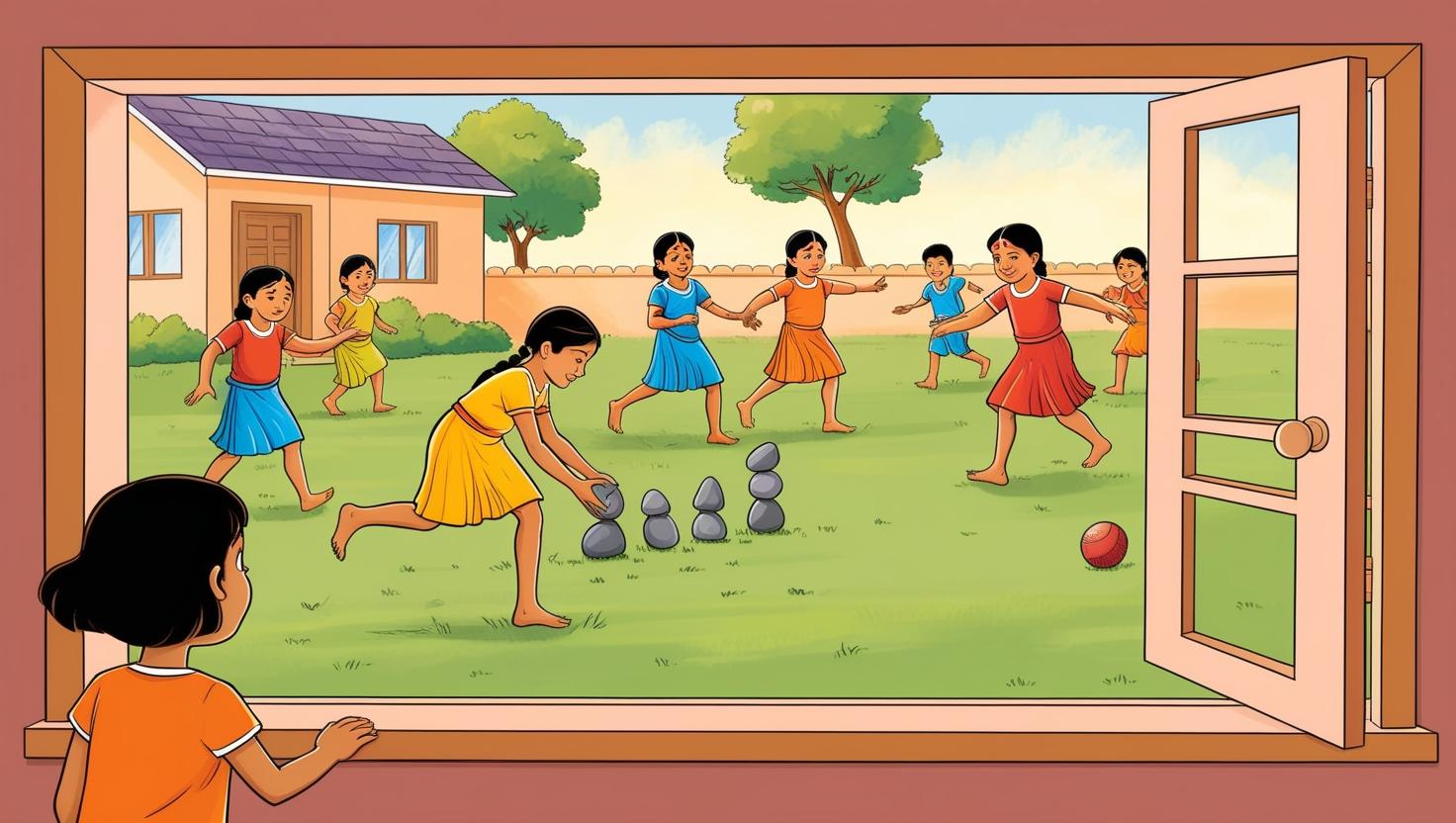
Meena sat by her room’s window and watched a group of children playing Pitthu (Seven Stones). Meena keenly followed a girl about her age. She was skillfully stacking the stones one atop another while effortlessly dodging the ball her opponents hurled at her. Her pigtails bounced as she ran.
A ball struck her back, and the opposing team erupted in triumphant laughter. But wait—when she turned, the tower of seven stones was already standing tall. She had completed the stack without toppling it. Just like that, the opponents’ victory turned into an embarrassing defeat.
Meena, watching from her window, burst into laughter. She was impressed. She wanted to meet that girl, to join the game—but hesitation held her back.
By evening, slowly, the family started noticing little things they liked. It wasn’t all bad, though. The paddy fields glowed golden in the sunlight, and the local folk songs had a charm that was hard to ignore. The neighbors, despite the language barrier, were helpful in small but significant ways.
And so, their story began—not just of surviving in a new place but of finding unexpected friendships, breaking stereotypes, and learning that beneath all the differences, people are just people.
This was only the beginning for the Ghosh family and their life in Khurda Road. But for Meena, that first glimpse of that confident, smart girl felt like a spark, one that hinted at a friendship that might just change everything.
PS: I’m participating in #BlogchatterA2Z

 Cerebration
How sweet! Unity in diversity and finding new beginnings in the most unexpected of places.
LikeLiked by 1 person
Yes true..this is just the beginning!
LikeLiked by 1 person
Such a cute tale this is. True, if we just learn to see the good.
LikeLiked by 1 person
Indeed! Thank you for reading
LikeLike
I could so relate to the Ghoshs’ transfer and settling into a new place. What a wonderful start to the story!
LikeLiked by 1 person
Thank you so much, Suchita! Your comment means a lot and will inspire me to steer the story in the right direction ♥️
LikeLiked by 1 person
You’ve got me hooked, Pinki! I want to know what happens next! Love your writing and story telling style! I will be back tomorrow!
LikeLiked by 1 person
Hey, thanks, Mayuri! Your comment is a real booster for me. I’ll make sure the story keeps you intrigued when you’re back tomorrow!
LikeLike
//as she clutched her favorite doll and peeked shyly at the children playing outside.// I connected with Meena. I felt like I was there. Forced to migrate at her age, I understand her situation. Don’t worry Meena. I’m with you.
LikeLiked by 1 person
I’m so glad that you feel connected to Meena! Thank you for being there with her.
LikeLiked by 1 person
Do I smell some autobiography here?
Good narration.
LikeLiked by 1 person
Haha, not an autobiography, but a blend of someone else’s biography with a touch of fiction. Good guess, though! Thanks for reading.
LikeLike
I’m looking forward to this friendship between Meena and the confident girl. This seems like a story I’m totally going to enjoy. Nice start, Pinki 🙂
LikeLiked by 1 person
Thank you so much! That truly means a lot coming from you. I hope to keep you engaged and entertained with the story!
LikeLiked by 1 person
Seems like a strong beginning! Looking forward to the rest
LikeLiked by 1 person
Thank you so much!
LikeLike
Simple narration, small-town settings, desi flavour. Almost everything I like 🙂
Looking forward to how this story unfolds.
Cheers,
CRD
LikeLiked by 1 person
Thank you so much! It would be nice to have you on this journey..
LikeLike
It feels familiar as I am from Bhubaneswar . Loved reading it. Waiting for the next chapter already !
LikeLiked by 1 person
Glad that the story resonates with you
LikeLike
The beginnings of a new friendship! The hesitation to accept change, the stress of uncertainties, and the gradual acceptance come across clearly in your writing.
LikeLike
Happy to have discovered yet another Bengali blogger from the community. I have spent my childhood and early youth in the railway town of Chittaranjan where we had some Oriya families as our neighbors. I remember having their delicious Khichdi and I haven’t eaten such delicious khichdi ever again in my life. Your story has my heart.
LikeLike