

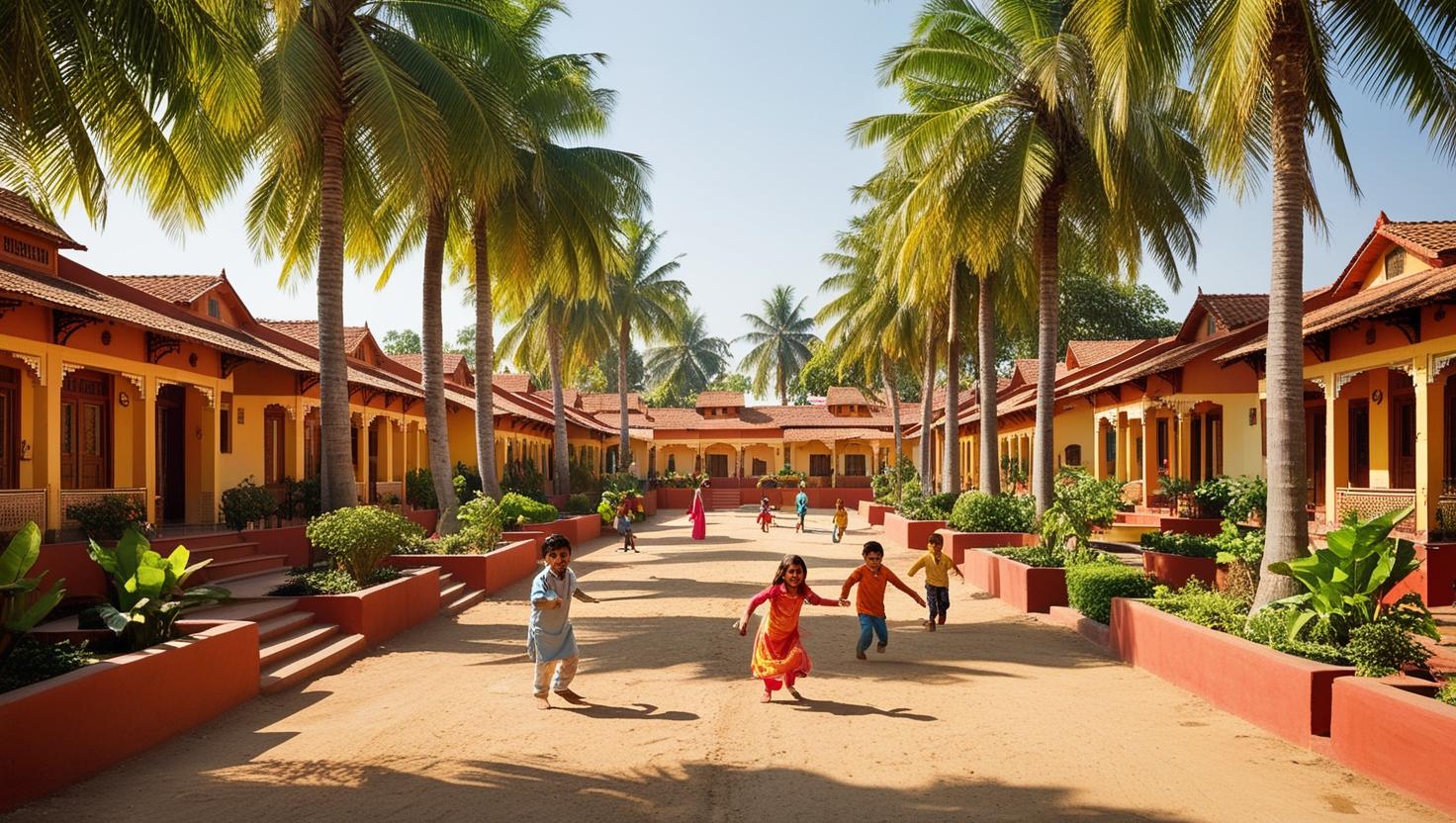
The thing about Khurda Road was that it wasn’t just a place—it was a living, breathing entity with a personality of its own. The streets were narrow, shaded by towering palm trees, and the houses that were identical in design but distinct in spirit. They stood like nosy relatives, always up in each other’s business.
Some houses had front yards decorated with intricate rangoli that changed every morning. Others had gardens bursting with tulsi and marigolds, fiercely guarded by elderly grandmothers whose mission was to chase away kids with a speed that defied physics. And if slippers had homing devices, theirs certainly did.
At first, Meena thought this neighborhood was worlds apart from their old one in Kolkata. But as the days passed, she realised it wasn’t all that different. Even there, people lived like a close-knit community—everyone knew everyone, and news traveled fast. But here, privacy was an even rarer commodity. If something happened on one end of the lane, the other end knew about it before it even finished happening.
“The milkman comes at six. If you want fresh milk, wake up on time,” their neighbor Mrs. Mishra declared on the very first morning, leaning over the boundary wall as if she had been waiting for this exact moment.
Meena’s mother, still half-asleep and struggling to fix her saree pleats, managed a polite smile. “Of course, I’ll remember.”
And then there was Mr. Sharma from three houses down—self-appointed as the local news broadcaster. If something happened in the neighborhood, you could bet he knew about it first.
At the far end of the lane lived Mr. Mohanty, a man with a heart so golden it could outshine a treasure chest. Always ready to help, always smiling—a true Samaritan, though his children often rolled their eyes at his inability to say no to anyone.
And then there were the D’Souzas—the warm, ever-smiling Anglo-Indian couple who owned the bakery. If love had a smell, it would be their Christmas cakes.
Just across from the D’Souzas’ cheerful home was a house no one talked about—the only one with its windows perpetually shut and curtains drawn even on the brightest days. Its white paint had faded to an eerie yellow, and the mailbox overflowed with unopened letters.
When Meena asked about it, Kasturi simply shrugged, eyes darting away. “No one lives there anymore,” she said, but it sounded more like a line she’d been told than something she believed.
Near the entrance of the neighborhood was the heart of the colony- Basu Bhaina’s (bhaina as in brother or bhaiya) grocery shop. It was a tiny, overstuffed haven of everything from rice and lentils to cheap plastic toys that children eyed with unfulfilled longing. His shop was less a store and more a parliament of unsolicited opinions.
People gathered there not just to buy essentials but to solve the nation’s biggest problems, one heated debate at a time. Prices, politics, cricket—nothing was off-limits. If you wanted to know what was going on in Khurda Road (or possibly in the world), you only had to loiter there for ten minutes.
The neighborhood was a mini India—diverse, chaotic, yet miraculously harmonious. Everyone belonged, even if they didn’t always agree.
One afternoon, as Meena and Kasturi passed by the grocery shop, they noticed a group of men huddled outside, their voices low, their expressions serious.
“Election time is coming. These fights are only going to get worse,” one of them muttered.
Meena glanced at Kasturi, but her friend was already tugging her away, conveniently switching the topic. “Forget them! A fair is coming up next week! You have to try the jalebis—they are the best in the world.”
Despite the warmth, the shared food, and the endless invitations for chai, Meena couldn’t shake off the feeling that something else lingered beneath the surface. The laughter, the routine, the kindness—it all felt real.
But so did the hushed conversations. The quick glances. The way voices dropped when certain topics arose.
Maybe she was overthinking it.
Or maybe, in a neighborhood that felt like one big family, there were secrets hiding in plain sight.
PS: I’m participating in #BlogchatterA2Z

 Cerebration
I’m thinking something terrible is going on that no one wants to talk about. Something connected to the empty house!!!!
LikeLiked by 2 people
Hmmm only time can tell! Thanks for reading.
LikeLike
There are always some elements who love to disrupt the peace! I am very curious about that house though, I don’t think it is empty. I just hope it isn’t being misused!
LikeLiked by 1 person
Interesting guess! Or is it a bullseye? Only time will tell. Thanks for taking the time to read.
LikeLike
Truly, that’s the Indian society. The deviation between the frequency of expressed relations and frequency of undercurrent is often significant. I loved your description of the neighborhood. The AI generated image adds value.
That’s a cliche. But you rephrased it well.
Your narrations of actions – Mrs Mishra leaning on the compound wall, Meena’s mother struggling to fix saree pleats… – brings scene vividly to life.
ha ha!!
I am curious about the haunted house, though I hope it’s not actually haunted!
Another lovable chapter. Keep the words flowing!
LikeLiked by 1 person
Thank you for your keen observation and detailed feedback—it means a lot. Whenever self-doubt creeps in, words like yours serve as a powerful motivation.
LikeLiked by 1 person
I am curious to know about the empty house and what is this tension in the air as if some storm is about to brew ?
LikeLiked by 1 person
Something is definitely brewing on the streets of Khurda—only time will reveal what it is. Thank you so much for taking the time to read.
LikeLiked by 1 person
Just read your “Part 4: Discovering the Neighborhood,” and I felt like I was right there in Khurda Road with Meena. Your descriptions of the narrow streets shaded by palm trees and the houses with their unique personalities painted such a vivid picture. I could almost hear the chatter at Basu Bhaina’s grocery shop and smell the D’Souzas’ Christmas cakes. The way you captured the close-knit community dynamics, from Mrs. Mishra’s early morning advice to Mr. Sharma’s neighborhood news updates, felt so authentic and relatable. The hint of mystery surrounding the shuttered house added an intriguing layer to the narrative.
LikeLiked by 1 person
Thank you so much for reading. I’m truly glad the narration was able to deliver the essence it intended to.
LikeLiked by 1 person
I think a lot is going on in this deceptively warm neighborhood.
LikeLiked by 1 person
Indeed, the mystery will unfold in its own time. Thank you for taking the time to read.
LikeLike
Lol !
“fiercely guarded by elderly grandmothers whose mission was to chase away kids with a speed that defied physics. And if slippers had homing devices, theirs certainly did.“
You reminded me of my own grandmother who was so territorial about her jasmine tree and flowers and nobody could pluck them out except her, that too specifically for her daily prayers.
Why do I get a feeling communal discord is brewing in the lanes of Khurda btw.
LikeLiked by 1 person
Haha, haina? I think we all have such grandmothers — they’re truly adorable. That’s exactly what inspired me to include the context here.
Something’s definitely brewing… only time will tell.
Thanks so much for taking the time to read and for sharing the part that resonated with you — it means a lot!
LikeLiked by 1 person
Your narrative really describes the neighbourhood beautifully. And I like your sprinkling of figures of speech across this short and sweet writeup.
LikeLiked by 1 person
Thank you so much!
LikeLike
Neighbourhood iis something that always gives us a sense of belongingness, protection and togetherness. Loved the way you have woven this chapter. Shall check others too.
LikeLiked by 1 person
Thank you so much for taking the time to read the story!
LikeLike