

Life in Khurda Road was changing, but not in the way Meena or her family had hoped. The air felt heavier, as though the town itself was holding its breath. Conversations at the local tea stalls grew hushed. The communal harmony that had made the neighborhood feel like one big family seemed to be fraying at the edges.
Although the neighborhood still felt like a safe haven but the regular exchanges of meals and visits over tea gradually reduced. People sensed tension brewing and everyone felt safe behind the closed doors.
It started with whispers—rumors of unrest in nearby areas. The local paper reported incidents of clashes in Kolkata, barely 500 kilometers away. Mrs. Ghosh’s hands trembled as she read aloud, “Two neighborhoods in Howrah erupted over a small misunderstanding… shops burned… curfew imposed.”
Mr. Ghosh took the paper from her. “It’s far from us,” he said, trying to sound confident. But the tightness in his jaw betrayed him.
Even Meena, who had only just begun to adjust to life without Kasturi, sensed the unease. She heard it in the way her parents spoke in low tones after dinner, their words clipped, as though afraid the walls might overhear. She noticed it in her mother’s sudden habit of double-checking the locks before going to bed.
At school, the atmosphere was no better. Teachers hurried through lessons, glancing at the windows as though expecting trouble to barge in at any moment.
“Why is everyone so quiet?” Meena whispered to her bench mate, Riya, during recess.
Riya shrugged, her eyes darting around. “Papa says it’s not safe to talk about these things,” she mumbled.
That evening, on her way back home, Meena noticed a group of men gathered at the local tea stall. They were arguing, their voices rising and falling like a wave threatening to crash. Words like “us” and “them” flew through the air, sharp and cutting.
“Meena, hurry up!” her mother called from the porch.
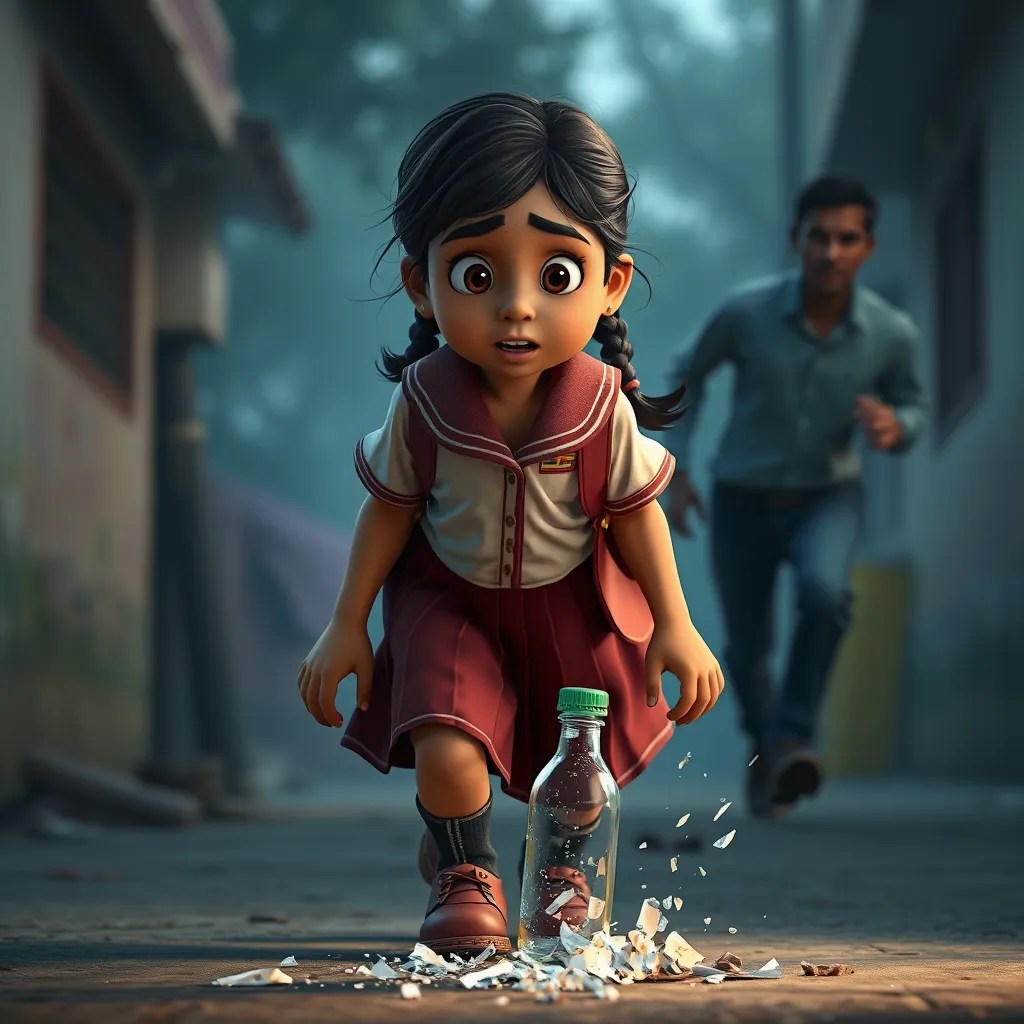
Just then, a glass bottle came flying from behind and shattered near Meena’s feet.
She froze.
Her mother, both anxious and angry, rushed to the main door. By the time she reached the gate, she saw Mr. Mohanty striding towards the house, carrying Meena in his arms.
Without wasting a second, he handed Meena to Mrs. Ghosh and said urgently, “Boudi, please stay inside and lock the doors. I need to check on Veenu and Krish.”
Veenu and Krish were his children, studying at the same school.
Meena’s mother murmured a thank you, but he only gave a quick nod before hurrying away.
“What’s happening, Ma?” Meena asked between sobs.
“Nothing just stay at home for few days,” Mrs. Ghosh replied, closing the door firmly.
But Meena knew better. The unease in her mother’s voice was enough to tell her that whatever was brewing may get worse.
Mrs. Ghosh has already started storing extra rice and lentils in the pantry, “just in case.” When Meena asked why, her mother snapped, “Don’t ask so many questions.”
But the cracks were impossible to ignore. The once-lively neighborhood seemed quieter, almost eerie. People no longer gathered for evening chats. The D’Souzas, who had always been the heart of the community, stopped inviting neighbors for tea.
One night, as the family sat down for dinner, the sound of raised voices drifted through the open window. Meena froze, her spoon halfway to her mouth.
“Close the windows,” Mr. Ghosh said quickly.
“But Baba—”
Meena’s mother came rushing from the kitchen to close the window. The voices outside grew louder, angrier. Someone shouted, “Go back to where you came from!”
Mrs. Ghosh clasped her hands tightly, muttering a prayer under her breath.
Who were these people? Nobody knew; the neighborhood was seeing and hearing such things for the first time. Everyone hoped things would die down slowly, but only if they knew how wrong they were.
That night, the voices eventually faded, but the fear lingered. Meena couldn’t sleep. She hugged Kassy tightly, wishing Kasturi were there to reassure her that everything would be okay.
The next morning, the Ghoshs went about their day, pretending everything was fine. But the truth was undeniable: the world outside their door was changing, and not for the better.
In the days that followed, Meena watched as the divide grew wider. Friends became strangers, and strangers became threats. It was as though the town had forgotten how to trust, and in its place, fear had taken root.
For Meena, it was a lesson she hadn’t expected to learn so young: sometimes, the scariest changes aren’t the ones you can see but the ones you can feel—the ones that creep into your heart and make you question the very ground you stand on.
PS: I’m participating in #BlogchatterA2Z
 Cerebration
It’s all so strange. What’s going on
LikeLiked by 1 person
Will reveal soon! Thanks for staying with the story.
LikeLiked by 1 person
The tension you’ve built here is deliciously maddening — like I’m bracing for something big but I don’t know what or when. I love how you let things simmer instead of rushing; it makes the story feel layered and alive. Every character seems to be holding back something and that makes it even more intriguing. I could literally feel the energy shift in those quieter moments — like the calm before a storm. Your writing makes me feel everything without spelling it out, and that’s such a rare gift. I’m honestly so invested in what’s going on and what’s going to explode next. This part left me restless in the best way possible.
LikeLike
Why fate plays in Meena’s life, one after another? She is too small for this. God please be kind.
The language you use to show the tension definitely helped the story line.
//
he said, trying to sound confident. But the tightness in his jaw betrayed him.
She noticed it in her mother’s sudden habit of double-checking the locks before going to bed.
sometimes, the scariest changes aren’t the ones you can see but the ones you can feel
//
Looks like the story takes a different direction. Riya and Mr Mohanty are joining our journey too. Interesting.
All the best.
LikeLiked by 1 person
Thank you so much for noticing and appreciating the subtleties of the story and the expressions! It really means a lot. Thank you.
LikeLiked by 1 person
‘..sometimes, the scariest changes aren’t the ones you can see but the ones you can feel—the ones that creep into your heart and make you question the very ground you stand on.’
This is so true!
LikeLiked by 1 person
Indeed! I can feel this line too!
LikeLiked by 1 person
Khurda Road may just remain in history and memories in the coming days. I feel a sense of foreboding. This isn’t going to have a happy ending, is it?
LikeLike
Oh-oh! This twist took me by surprise! That is exactly what life does too, doesn’t it? Like it did to Meena and Kasturi and now to the neighborhood. I am hooked and want to know what happens next!
LikeLiked by 1 person
I’m thrilled to know the story intrigues you. Your comment is truly encouraging. Thank you!
LikeLike
Ohh My God !! Communal Clashes are always filled with anxiety laden atmosphere. Your posts are totally making me nervous !
LikeLiked by 1 person