

The riots were finally dying down. The once deafening chaos of shouts, screams, and gunfire had dulled to sporadic murmurs, like an ember struggling to stay alive. It had been days—maybe weeks—since the neighbourhood had been torn apart. Time had blurred.
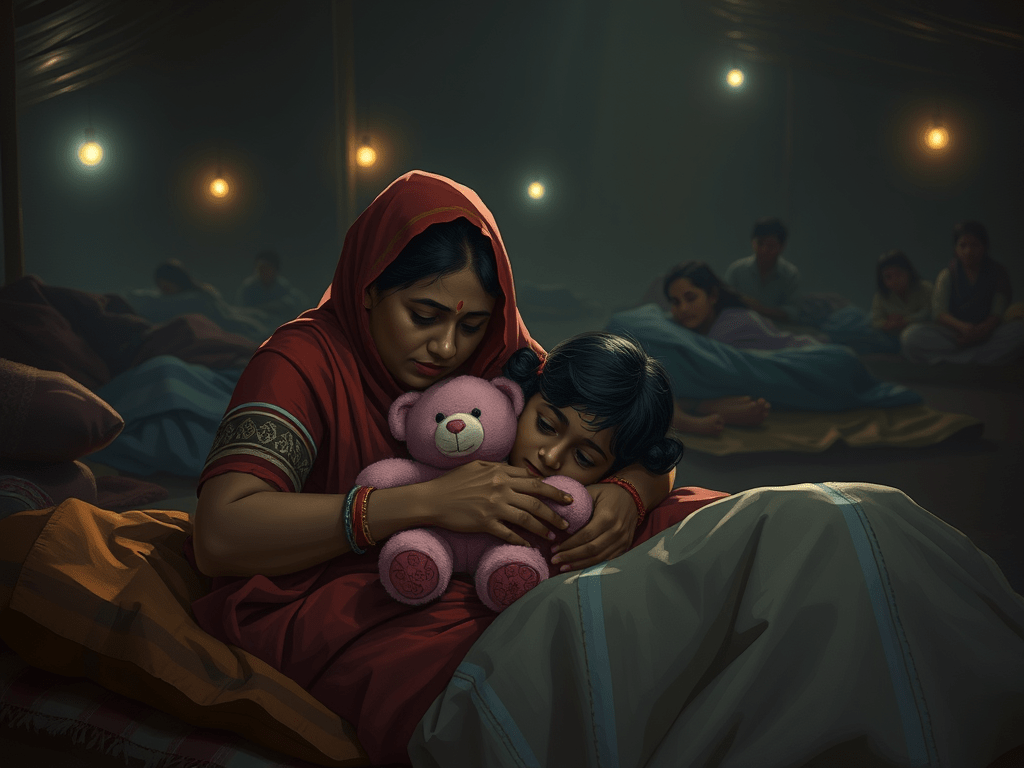
Inside the DM’s bungalow, life had settled into a strange routine. The large hall, which once hosted political gatherings and officials, had turned into a shared living space for the refugees.
Mats and blankets were spread across the marble floor, families huddled together, whispering about what they had left behind. Some had lost their homes. Some didn’t even know if their homes still stood. Some had lost family members. And some—like Meena and her mother—were just waiting, waiting for the day they could return to normal.
Food was simple. The police and volunteers distributed rice, dal, and a few vegetables twice a day. People no longer craved taste—just something warm to fill their stomachs. Water was rationed, though there was always an underlying fear of contamination after the incident with the brick powder.
Bathing was a luxury, and everyone had started to smell the same—a mix of sweat, worry, and damp clothes. But no one complained. Complaints belonged to the privileged, not the displaced.
That evening, as the emergency lights flickered, Meena lay curled up beside her mother, hugging Kassy. The pink teddy was a comforting reminder of Kasturi, of days when life was simple—when their biggest problem was deciding which ice cream flavor to pick after school.
But tonight, the weight of the world pressed on her small shoulders.
“Do you think Kasturi is okay? She must be eating burgers and drinking Coke in America. Maybe she has a new best friend now.” Her fingers clutched at the soft fur. “But I still have you, Kassy. You won’t leave me, right?”
Her mother, who had been pretending to be asleep, opened her eyes and gently stroked Meena’s hair. “You miss her a lot, don’t you?”
Meena nodded.
“Ma,” she whispered, breaking the silence. “Why were people fighting outside? Just because we are Bengalis?”
Her mother hesitated, then sighed. “Sometimes, people let differences divide them instead of seeing what makes them the same.”
Meena frowned. “But you always say people are people, no matter where they’re from.”
Her mother smiled sadly. “Yes, beta. But not everyone understands that. Some people think where you were born, what language you speak, or what food you eat makes you different. And sometimes, they are scared of differences.”
Meena sat up. “That doesn’t make sense. Kasturi and I are different, but we’re best friends. We never fight over being different.”
Her mother tucked a strand of hair behind Meena’s ear. “Because love and friendship don’t see differences, Meena. You and Kasturi see each other as people first. But some people… they see labels before they see hearts.”
Meena thought about this for a long time. The world outside was complicated in a way she didn’t understand. But in her heart, it was simple.
That night, as Meena drifted off to sleep, she didn’t know if her home was still standing, if she’d ever sit in her old classroom again, or if Kasturi would write to her.
But she did know one thing—what she and Kasturi had was real. And maybe, just maybe, the world could learn from that.
The next morning, something different was in the air. The mob’s repeated attempts to escalate the violence had been thwarted by swift action from the authorities.
Under the strict orders of the District Magistrate, authorities took swift and decisive action. The water supply, tainted by the mob’s earlier efforts, was immediately cleaned and restored, ensuring the residents had access to safe drinking water.
Reinforcements arrived from neighbouring districts, and curfew orders were rigidly enforced. A small but determined group of community leaders worked tirelessly to mediate and calm tensions. Their efforts played a crucial role in curbing the unrest.
Slowly but surely, the flames of hatred began to sputter, unable to find new fuel.
For the first time in days, someone laughed—not the nervous chuckles people let out when they tried to comfort each other, but real, full-bodied laughter. A group of children had started a game of kabaddi in the backyard of the bungalow. Their giggles filled the air, momentarily drowning out the weight of uncertainty.
A woman was braiding another woman’s hair. An elderly man was reading poetry to a small audience. Someone had even found an old harmonium in a storage room, and a few people gathered around as a man sang an old Kishore Kumar song. The melody was slightly off-key, but nobody cared.
Meena and her mother were sitting in a corner when Mr. Mohanty walked over with two steel plates. “Here,” he said, handing them food. “Extra serving of dal today. A small celebration because things are calming down.”
Meena poked at her food with a spoon. “Is it safe to go home now?”
Mr. Mohanty sighed. “Not yet, beta. But soon.”
Her mother asked cautiously, “Any updates from our neighborhood?”
His face darkened for a moment. “Some houses were burned down.”
Meena’s heart stopped. “Ours?”
Mr. Mohanty hesitated, then shook his head. “Hope it stays intact. But some shops… they didn’t survive.”
“Basu Bhaina’s shop,” he said quietly.
“Did… did the shop—?” Meena’s mother left the sentence hanging midair.
“Burnt down. Nothing left.” He paused, eyes clouding.
Meena’s grip on her spoon tightened. Everything was changing. Everything was disappearing.
Mr. Mohanty continued, “Turns out, the empty house in front of the D’Souzas—the one no one ever really noticed—was rented out a month ago. No one asked too many questions. But the police think those men were outsiders, pretending to be locals. They may have started the whole thing. All for the elections.”
Meena felt her stomach twist. She remembered walking past that house with Kasturi, hearing voices inside, laughter that didn’t belong. She hadn’t thought much of it then.
Mr. Mohanty glanced down, “Someone must’ve known. It’s hard to live here and not notice.”
The weight of that sentence hung heavy. In a neighbourhood that knew who bought Maggi at midnight, how had no one seen this coming?
Later that evening, she sat by herself, hugging Kassy. She had spent so many days holding onto fear, onto grief, onto what she had lost. But maybe, just maybe, there was still something left to hold onto.
Hope.
Hope that one day, she’d sit on her own bed again.
Hope that she’d hear from Kasturi.
Hope that this too, like all storms, shall pass.
PS: I’m participating in #BlogchatterA2Z

 Cerebration
“But she did know one thing—what she and Kasturi had was real.” This line strikes a chord. I loved the most the scene of bringing life back to mainstream. How beautiful is that scene! Poetry, singing, playing, sisterhood – everything made feel that there was still hope. Lovely!
LikeLiked by 1 person
Thank you. Yes, hope is something that keeps life moving forward despite the despair
LikeLike
//Complaints belonged to the privileged, not the displaced.//
Your bullet hit the target. The sentence is razor-sharp—well done!
Meena’s longing for Kasturi made me feel sad. I hope things work out for them soon. The growing sense of community is uplifting. It would be great if Mr. Mohanty join them soon. I hope that happens.
All the best.
LikeLiked by 1 person
Complaints belonged to the privileged, not the displaced.” – rings so true!
I hope their house still stands. And I hope their faith in society and in humanity in general has only shaken momentarily instead of dying forever.
LikeLike
‘“Sometimes, people let differences divide them instead of seeing what makes them the same.”
How wise Mrs. Ghosh is!
So the whole thing was a political conspiracy. How unfortunate!
LikeLiked by 1 person
Yes we learn some great life lessons from the worst tragedy of life! Thanks for stopping by!
LikeLiked by 1 person
Love how wise Mrs Ghosh is and how beautifully she explains thins to Kasturi. We need more people like her. Glad that the situation is calming down. However I feel sad that Basu Bhaina’s shop is no more.
LikeLiked by 1 person
Some were fortunate to survive, but sadly, not all. Lives were lost, and memories were tragically erased by the devastation of this riot. Thank you for sharing your thoughts about the chapter!
LikeLike
In times of turmoil we are left with nothing but Hope. Lovely write !
LikeLiked by 1 person