
How are you breathing at this very moment?
Breathing is the most fundamental activity that keeps us alive, yet we often overlook it. Even as you are reading this, your body is breathing and carrying out the process of respiration without your conscious effort. So, take a moment to observe your breath right now.
We know that breathing is more than a life-sustaining function. It connects our body and mind. It informs us about the state of our emotional and physical well-being.
Have you ever noticed that when we’re anxious, breathing is shallow? And when we are calm, it flows deep and even.
How many times in a day do we pause to pay attention to our breathing? Hardly, right? Whether you are a beginner or someone looking to deepen your practice, understanding the basics of breathing can serve as a powerful gateway to mindfulness.
Here Are Some Startling facts about Breathing
- The Healing Power of a Breath: Breathing can alter our physiology in seconds. Research by the HeartMath Institute indicates that slow, controlled breathing can synchronise heart rate and brain function, thereby fostering emotional stability and resilience.
- Breathing Affects Brain Size: This fact just blew my brain! A study by Harvard University found that people who regularly practice mindful breathing or meditation tend to have larger brain areas associated with attention and emotional regulation. This highlights the direct impact of breathing on cognitive function and mental health.
The Scientific Link Between Breathing and Mindfulness
Scientific research has found that mindful breathing stimulates the parasympathetic nervous system, often termed as the “rest-and-digest” system. This would lower heart rate, reduce blood pressure, and help one relax. In addition, it increases our concentration and ability to process emotions. Therefore, all these advantages make it a tool for mental and emotional well-being.
Mindful breathing can help you navigate challenges from stress to heartache. Try it!
Fascinating Connections Between Breath and Mindfulness
- Pranayama’s Hidden Depth
The ancient practice of Pranayama involves more than inhaling and exhaling. It teaches us to pause and appreciate the spaces between breaths. These pauses cultivate patience and awareness, qualities essential for mindfulness. - Breathing as a Stress Detector
Researchers found that we unconsciously hold our breath when stressed. This behaviour is called “e-mail apnea” or “screen apnea,” and mostly occurs when working on digital devices. The term, e-mail apnea, was coined by Linda Stone, a former executive at Apple and Microsoft, in 2008. She says, “It is a temporary absence or suspension of breathing, or shallow breathing while doing email.” Becoming aware of this habit can help us release tension and refocus.
The days I am unable to work out, I make sure to do Pranayama at least. It is liberating, calming, and hardly takes any space or time.
The term “Pranayama” is derived from the Sanskrit term “Prana” which translates to vital life force and “Yama” which means regulation.
Pranayama involves the process of inhalation, a mindful pause, and exhalation followed by a mindful pause. These mindful pauses help in conscious breathing.
If you are a beginner, I’ve got you covered with the basics.
How to Begin: Fundamentals of Breathing Techniques
1. Consciousness of Breath
This is the simplest practice: observe your breath without trying to change it. Here’s how to begin:
A. Sit with your back straight and your hands resting on your lap.
B. Close your eyes and take a minute to settle.
C. Observe the silence surrounding you and then notice the natural rhythm of the breath as it flows in and out.
D. If your mind wanders, gently guide the mind back to your breathing.
Once you are able to do this, you can progress to other techniques depending on your comfort level.
2. Deep Belly Breathing (Diaphragmatic Breathing)
This helps soothe the nervous system and encourages relaxation.
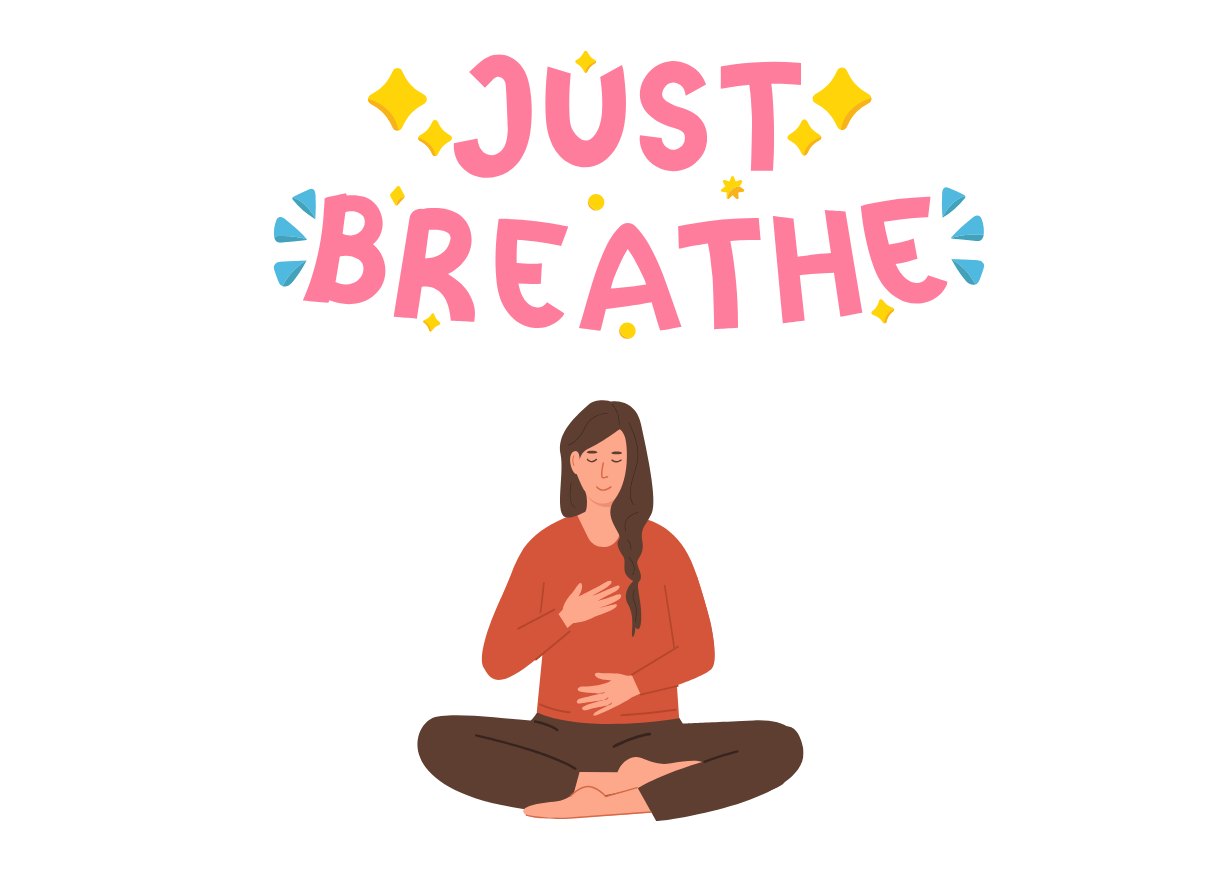
A. Put one hand on your chest and the other on your stomach.
B. Inhale deeply through your nose, feeling your belly rise as your chest stays still.
C. Exhale slowly through your mouth, feeling your belly fall.
D. Repeat for 5-10 minutes.
3. Box Breathing
This patterned breathing technique is fantastic for concentration and to reduce stress.
A. Inhale through your nose for a count of 4.
B. Hold your breath for a count of 4.
C. Exhale through your mouth for a count of 4.
D. Hold your breath again for a count of 4.
E. Repeat the cycle for 5-10 rounds as per your comfort.
Pregnant people and people with high blood pressure or any other chronic disease should avoid box breathing or consult their physician.
Incorporating Mindful Breathing into Daily Life
Mindful breathing doesn’t have to be confined to formal meditation sessions. Here are some ways to integrate it into your routine:
- Morning Ritual: Start your day with 5 minutes of mindful breathing to set a calm tone.
- Stressful Moments: Take a couple of deep breaths before speaking up when dealing with a trying situation.
- Daily Transitions: Apply mindfulness breathing to the transitions of commuting or moving between tasks.
I know sometimes it is easier said than done. So, let’s talk about the most common challenges that we face when we begin the process.
Challenges to Mindful Breathing Practice
- Wandering Mind: It will wander sometimes or may wander throughout the practice. It is natural for your mind to wander. Don’t give up, simply refocus on your breath without judgment.
- Lack of Consistency: Most people fail to stay on the path for long. So, set tiny, achievable goals, like 2 minutes of mindful breathing each day, and gradually increase as it becomes a habit.
- Uncomfortable Feelings: When deep breathing is new or feels uncomfortable, take shorter sessions, and let the body adapt with time. You are the best judge of your body, so either take shorter sessions or avoid in case you feel discomfort. It is best to consult your doctor.
So, now take a deep breath in, and let it carry you to a place of balance and serenity.
References:
Can mindfulness change your brain? – Harvard Health
Breath meditation: A great way to relieve stress – Harvard Health
What is pranayama | Types of Pranayama and Breathing – The Art of Living
PS: This blog post is part of ‘Blogaberry Dazzle’ hosted by Cindy D’Silva and Noor Anand Chawla in collaboration with Mister Tikku.
 Cerebration
Mindful breathing is indeed powerful. I started practising it to combat stress but now it is something that comes to me naturally and I feel calmer and happier with regular practice.
I am sharing this post with others so that more people can benefit from this practice.
LikeLiked by 1 person
Thank you so much for sharing your experience here. Glad that you are spreading the word. Thanks 🙏
LikeLike
As you mentioned, Pinkii, it is easier said than done. I have been practising yoga and pranayama for more than 14 years now. But when my anxiety attacks occur I am unable to practice any kind of breathing. I know all the techniques and I write about them, but bottom line is I am struggling myself.
LikeLiked by 1 person
I am sorry to hear about your struggle and about your anciety attacks . I wish you more strength, Harjeet. What I have learnt from my own practice is atleast with regular practice, I am less restless and anxious than before. I urge you to notice if the episodes have reduced over time. Or may be practice with a teacher, that might help!
LikeLike
I appreciate this reminder to truly notice my breath—I often forget how powerful mindful breathing is, especially during stressful moments. It’s a simple tool that really helps me reconnect and find calm.
LikeLiked by 1 person
Thank you so much. I am glad the post resonated with you!
LikeLike
This was such a calming and insightful read. I actually paused to check in with my own breath while reading and realized how shallow it had become after a long workday. Loved the way you broke it down with science, emotion, and practicality. The bit about email apnea hit home (guilty). Thank you for the gentle reminder to pause and just breathe.
LikeLiked by 1 person
Thank you so much. I am glad that the post made you pause and observe your breath! ❤️
LikeLike
Well explained Pinki. I start my day with a yogic breathing practice and end the day with some more deep breathing. I find box breathing very effective in helping pump in more oxygen and also increasing stamina.
LikeLiked by 1 person
Thank you so much. Indeed! Breathing exercises just keep me grounded, calm, and serene. I am glad to hear about your experience with the breathing techniques!
LikeLiked by 1 person
I love how you keep it crisp and simple but pass on so much information. I have recently been trying to practice pranayam and it feels hectic initially so I try with guided mediation playing in the background. Also I wasn’t aware of screen apnea and being half of my day in front of screens it has really made me alert for mindful breathing. Thank you for such a beautiful blog!
LikeLiked by 1 person
Thank you so much for reading. I am glad you found something useful in there 😊
LikeLike
It’s amazing how something as simple as breathing can be such a powerful tool for mindfulness. Definitely trying the box breathing technique next time stress hits!
LikeLiked by 1 person
That’s great! I would advise you to practice breathing regularly, may be that stress will think twice before hitting you! 😅
LikeLiked by 1 person
hahaha… thanks Pinki 🙂
LikeLiked by 1 person
Meditation for chakra Healing I am doing these days and Trust me it really made me feel different and better in life. We do the breathing when we heal the chakras and it feels divine calming mind body and soul.
LikeLiked by 1 person
Wow, that’s wonderful to hear! Meditation for chakra healing is l definitely powerful, you might be experiencing renewed energy. Thanks for sharing!
LikeLike
Mindfulness is a necessity in this fast paced life. I have been told several times to practice breathing, and now you have shared so many techniques, I feel it’s the sign for me to began with it starting from basic breathing technique and getting better at it.
LikeLiked by 1 person
I am glad that the post has motivated you to finally give it a try! Go for it 👍
LikeLike
This is such a calming read. I loved how you broke down the techniques ; box breathing is something I’m definitely going to try during work breaks!
LikeLiked by 1 person
I am glad to hear that! Thank you for sharing your thoughts here!
LikeLike
Though I am regular with my yoga , breathing isa technique, I am yet to master. I am a little too impatient with it. Though I often practice two inhalation and one exhalation to calm me down
LikeLiked by 1 person
You have already taken the first step with your current practice. It may be short but its a good start. You will get there eventually! All the best!
LikeLike
this is an insightful post. I will definitely try some of the techniques mentioned in your post
LikeLiked by 1 person
I am glad to hear that. Thank you so much
LikeLike
Such an eye-opening post. I never thought breathing had such concepts and paras. Really, I have to start working on my breathing too.
LikeLiked by 1 person
Breathing can do wonders. Give it a try! Thank you!
LikeLike
My oxygen levels had gone very low and box breathing has been very effective getting them back in range. Thanks for sharing such an important post.
LikeLiked by 1 person
I am so glad to hear that box breathing helped you regain your oxygen levels. Thanks for sharing your experience!
LikeLike
What you mentioned is true! My mind wanders to all the possible places on earth when trying mindful breathing or meditation. It seems like a million thoughts are always running in my head. I will try shorter stretches. Thanks for the tips.
LikeLiked by 1 person
Thank you, Shalini! Do try it 👍
LikeLike
A beautifully written and insightful post! I loved how you simplified the concepts of mindful breathing. Box breathing is my go-to during stressful days—calms me instantly. Thank you for this gentle reminder!
LikeLiked by 1 person
I am glad that you found the words to be useful. And thank you for sharing your thoughts!
LikeLike
Mindful breathing needs practice and takes time to achieve. However, it’s one of the best things we can do for our overall emotional and physical health. Great tips!
LikeLiked by 1 person
Thank you so much!
LikeLike
I do Pranayam and box breathing daily. Box breathing is an excellent way to increase stamina and lung capacity. I also find deep breathing effective in refreshing a saturated mind. Thanks for sharing this lovely reminder to pause and breathe.
LikeLiked by 1 person
Thank you so much fir sharing your thoughts! I am glad to learn abour your practice too!
LikeLike
This is an important reminder for incorporating mindfulness. Not only breathing, but it should be a part of our every step of life.
LikeLike
Breathing is the most common thing in our life that we take for granted! If we even do this one thing mindfully, I guess, many problems will get solved
LikeLike
I have been hearing a lot about Box Breathing. But never practiced. Thanks for the types. Yes as you said it would clam the mind and I really want to get going with it
LikeLiked by 1 person
I am glad you found the words to be useful. Go for it! And thank you for sharing your thoughts!
LikeLike
These practices really do help with anxiety. A well-researched post.
LikeLiked by 1 person
Thank you 😊
LikeLiked by 1 person