


When you make a decision, do you think it is your conscious effort? Is the decision completely yours?
Well, not really!
Did you know that up to 95% of our daily decisions are made unconsciously? From choosing what to eat to reacting to a stressful email, much of what we do is guided by habits and automatic processes that fall under a predetermined pattern made by the brain.
A 2019 study by UNSW Sydney revealed that our brains often make decisions before we become consciously aware of them. Using neuroimaging, researchers observed that brain activity could predict a participant’s choice up to seven seconds before they reported making it.
This finding highlights how unconscious processes play a significant role in decision-making, challenging the traditional notion of free will and emphasising the importance of cultivating awareness to bring more conscious intention into our lives.
It’s as though we’re passengers in our own lives, letting our subconscious mind steer the wheel.
This startling fact reveals two things:
- Our brains are efficiency experts, automating tasks to save energy for bigger challenges.
- We’re often unaware of how much control we’ve given to these patterns, even when they don’t serve us.
But here’s the good news: awareness is the key to breaking free. By becoming more conscious of these automatic behaviors, we can regain control and start living with intention.
The Science Behind Autopilot
Our brains are wired to save energy. Every time we repeat an action—whether it’s brushing our teeth, checking our phone, or reacting defensively to criticism—it becomes a habit. These habits are stored in a part of the brain called the basal ganglia, which automates them so the conscious brain can focus on new tasks.
Notice when you learn a new task, like driving, each step is carefully taken by the conscious brain. During this time, the prefrontal cortex is most active. The brainwaves are longer, consuming more energy. But as we practice it daily, slowly the brain becomes more efficient in the task, and it gets shifted to the basal ganglia. This is when driving becomes a habit and you can listen to songs or talk (not recommended) while driving.
While this system helps us navigate the world efficiently, it has a downside: we often operate on autopilot, unaware of the choices we’re making. This can lead to mindlessly scrolling through social media, overeating, or falling into negative thought patterns.
Awareness as a Disruptor
This automated system might be energy efficient and beneficial but in order to break a predetermined pattern or a negative habit, awareness is the key to disrupting the system.
Awareness acts as a spotlight, illuminating the patterns running quietly in the background. Here’s how it works:
- Pause: Awareness allows you to pause before acting. Example: When you reach for a snack out of habit, pause and ask yourself if you’re truly hungry.
- Observe: Pay attention to your thoughts and feelings to identify triggers and habits. Why do you always procrastinate? What emotions lead you to react defensively?
- Choose: Awareness empowers you to make intentional choices rather than defaulting to old patterns.
Practical Ways to Cultivate Awareness
1. Mindful Moments: Start small. Choose one activity each day—like drinking your morning coffee—and do it with full attention. Notice the aroma, the warmth of the cup, and the taste. This practice strengthens your “awareness muscle.” You can repeat this with meals. Trust me when I say the food tastes different, even better when we fully focus on the morsels without watching tv or mobile.
2. Name the Autopilot: Throughout your day, catch yourself in automatic behaviours. For instance:
-When you instinctively pick up your phone, ask, What was I about to check?
-If you react emotionally, pause and think, What triggered this response?
3. Body Awareness: Our bodies often signal emotions before our minds do. Regularly scan your body for tension or discomfort. Is your jaw clenched? Are your shoulders tight? These physical cues can reveal hidden stressors.
4. Journaling: Take a few minutes each day to reflect on moments where you felt truly present—and where you didn’t. Writing down these observations can help you identify patterns and areas to work on.
5. Mindfulness Practices: Meditation, breathwork, and grounding exercises are powerful tools for increasing awareness. It doesn’t require a significant amount of your time; even a single minute of deep breathing can bring you back to the present moment.
Conclusion
Awareness is like turning on the lights in a dark room. It reveals the hidden patterns that shape your life, giving you the power to change them.
So, take a moment today to pause, observe, and reflect. What patterns are running quietly in the background of your life? Awareness is your first step toward transformation.
References:
Cognitive Economy: The Brain’s Journey from Effort to Automation | by Oguzhan Polat | Medium
Autopilot Brain: Navigating Life on Mental Cruise Control
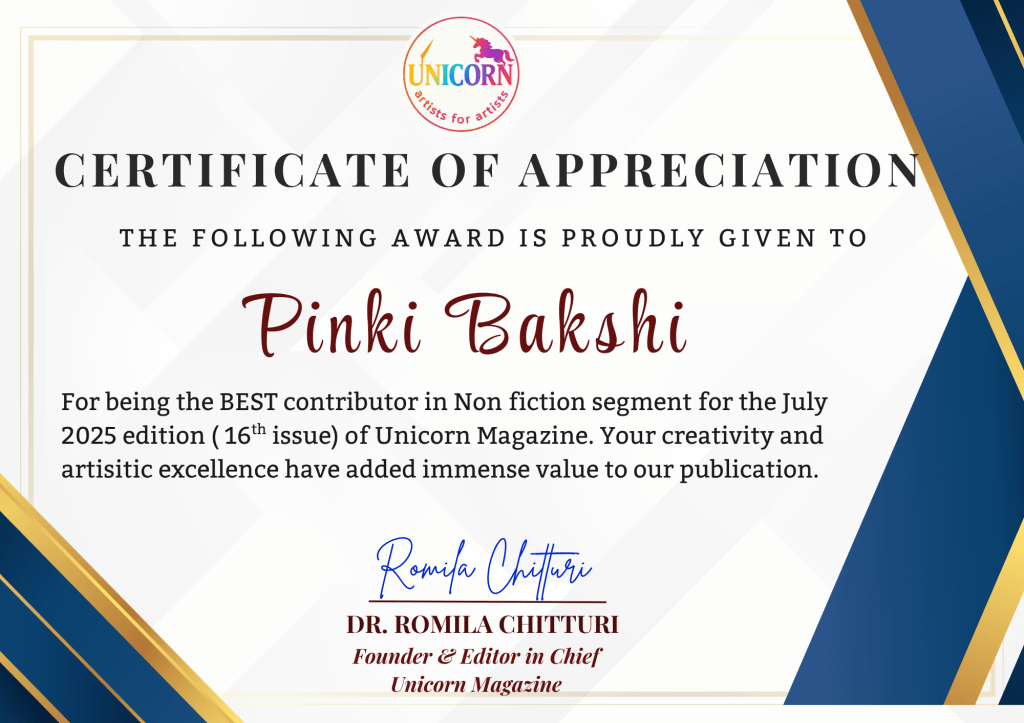
PS: This piece was originally written and published in the July 2025 edition of Unicorn Magazine, where it was selected as the Best Contributor in the Non-Fiction segment.
PS: This post is a part of the Blogchatter Half Marathon 2025
My book delves deeper into the themes I often write about here — love, memory, and human connections. Have you checked it out yet? You can find it on Amazon. Click Here

 Cerebration
A very good post which is so relevant these days. I liked that bit on us reaching for the phone. Millions of people do it around the world, but that doesn’t make it the right behaviour. I read somewhere that even if we do something it’s the mind that’s at work though it’s the body that doing the act. It’s so important to take control of our mind.
(My latest post: From memoir to mystery: My latest four reads)
LikeLiked by 1 person
Very insightful post! Love how you’ve taken time to look for the science behind our impulses, responses and habits.
Indeed, mindful awareness can lead to well-thought (and hopefully) and better decisions. Since the modern daily routine leaves us very little time, we need to keep some time aside for this.
LikeLiked by 1 person
Thank you!
LikeLike
Congratulations again on winning Best Contributor! 🎉
I found your take on breaking free from autopilot so real, the way you peeled back the layers of mindless routine and handed us the tools to actually be in control – felt like a mini revolution. Your voice shines here, my friend, and I’m already looking forward to what you’ll write next, of course for Unicorn.
LikeLike