

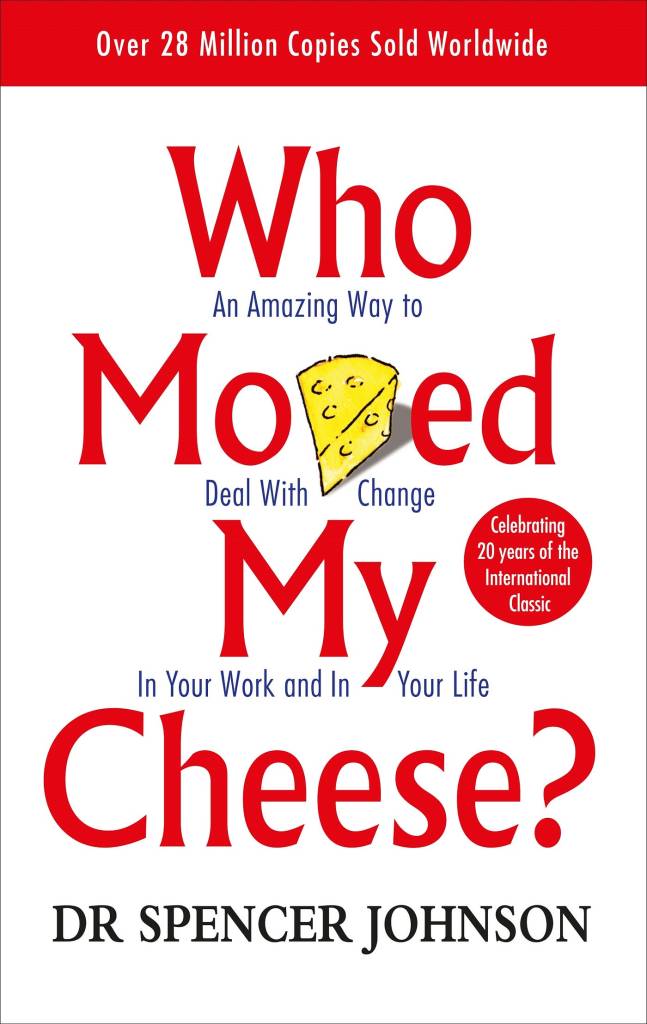

When I was in college, my father once brought home a book from his management training. It was a thin little book titled Who Moved My Cheese? The title intrigued me instantly, and I read it in one sitting. I realised the story was a metaphor—one that spoke about our lives, our desires, and the way we respond to situations beyond our control.
Years later, I felt the urge to revisit this book for Reading With Muffy Challenge (December prompt: Reading a classic), and surprisingly, the story felt fresh all over again.
Who Moved My Cheese? is a short motivational parable about dealing with change.
Summary
The story is set inside a maze and follows four characters—two mice and two little people—who are all in search of “cheese,” a metaphor for what we want in life: success, security, happiness, or stability.
When the cheese suddenly disappears, each character reacts differently. Some adapt quickly and move on, while others resist, deny, and cling to the past, hoping things will return to how they once were.
Through these contrasting reactions, the book highlights how fear, comfort, and habits can keep us stuck, while adaptability, awareness, and willingness to change help us move forward. The core message is simple: change is inevitable, and how we respond to it determines our growth and peace.
What I loved most about the book is its simplicity. The story doesn’t preach, nor does it offer complex strategies. Instead, it gently encourages readers to notice change early, let go of fear, and take small steps toward the unknown. The best part is how clearly this profound message is conveyed through a simple plot and even simpler characters.
As I immersed myself in the story, I couldn’t help but notice how often we don’t resist change itself—we resist the fear that comes with it. We stay in familiar corridors even when the cheese is clearly gone. We complain. We analyse. We hope. We wait.
However, when I look inward, I also realise that real-life change isn’t always as straightforward as putting on your running shoes and moving forward. There are emotions the book barely pauses for—grief, attachment, exhaustion. Sometimes, change hurts more than the story allows space for. And sometimes, staying still isn’t stupidity; it’s survival.
Still, the book does what it intends to do. It becomes a nudge when you are stuck. It speaks to moments when overthinking has exhausted you, and all you need is one clear thought: What if I tried something different?
And that’s where the heart of the story lies.
I would recommend this book to anyone—whether you’re a student, a working professional, or a stay-at-home parent. Change touches everyone’s life in one form or another. And that’s exactly where this book works.
PS: This post is part of the #readingwithmuffy challenge hosted by gorgeous Shalini.
PS: This blog post is part of ‘Blogaberry Dazzle’
hosted by Cindy D’Silva and Noor Anand Chawla in collaboration with Cerebration – Think with body, mind & soul
 Cerebration
This really a transformative book.
LikeLiked by 1 person
Yes, absolutely! Thank you for stopping by!
LikeLike
I had read this book so long ago, that I don’t remember anything about it. Thanks to your lovely review, which has piqued my curiosity, I will be reading it again.
LikeLike
I appreciate how you didn’t just summarise Who Moved My Cheese, but explored what the story actually feels like when you apply it to real life. Change isn’t an abstract concept — it’s uncomfortable, confusing, and often unwelcome. Your review captures that tension honestly, and makes the idea of adapting to change feel less theoretical and more human.
LikeLike
I heard a lot about this book. It was such a rage. But I haven’t read it. From your review it seems I might not need to read it because change is the only constant and I feel I have learned that lesson. Yet, I want to read it.
LikeLike
This remains one of my favourite non-fiction book. I love it and have written a micro-fiction based on this. That fond of it I am!
LikeLike
I read this book many years ago. To revive the content through your post was truly amazing.
LikeLike
I’ve not read this book despite its huge success, and more importantly, readers’ love (which comes above all for a book to appeal to me). Your review nudges me closer to pick it up. Great review.
LikeLike
this truly is a classic and you have chosen the perfect book for the reading challenge. I read this when I was in school and I love the simple message it conveys
LikeLike
Back in college everyone I knew had this book and we discussed it at length too. I’ll need to revisit it to remember more details. A good book for all ages.
LikeLike
You explained the book’s insights in such a clear and engaging way. Even though this isn’t my favouritre genre you made me reconsider giving this one a try.
LikeLike
I really appreciated how your review made this familiar fable feel fresh and relatable, showing both the simple wisdom about embracing change and the honest human emotions we all wrestle with when life’s “cheese” disappears, inspiring reflection and growth.
LikeLike
Thanks for refreshing my mind about Who moved my cheese. I read it a long time ago and I am glad you wrote this.
LikeLike
I remember back then this book was all a rage and almost required reading! it is funny how a thin book about mice no less has had such an impact on generations and how they understand behaviour.
LikeLike
Your reflections on change, adaptability, and mindset hit home, especially in a world that feels like it’s constantly shifting. I loved the way you connected the book’s simple story to deeper insights about growth, resilience, and moving forward with intention. It felt practical and encouraging like a gentle nudge to lean into change with curiosity rather than fear.
LikeLike
This is such a thoughtful take on the book.The way you connect it to real-life emotions like grief and attachment makes the review feel honest and relatable, not just motivational. It actually makes me want to pick it up again and see what cheese I might be clinging to.
LikeLike
Since I have not read the book, I cannot say anything about it. But your take seems to be quite unique.
LikeLike
You review made me curious about this book. Will get my hands on!
LikeLike
Not a non-fiction reader at all. But if I have to read one, I guess this could be the book…
LikeLike