

History often surprises us with stories of innovation, courage, and discovery, yet there are some moments that make us deeply uncomfortable.
Whenever I visit a zoo, it feels disheartening to see the wild animals in captivity. However, I start wondering, what if there is a world where the roles are reversed, or are we already in that world? What if we are the captives, and the animals are viewing us? These were just random thoughts until I came across human zoos in reality.
In the late 19th and early 20th centuries, large exhibitions were held across Europe and America to showcase cultures from around the world. These exhibitions were called ethnological exhibitions, but over time, they became known by a more unsettling name — Human Zoos.
One of the most well-known organisers of these exhibitions was Carl Hagenbeck, who began displaying groups of people from Africa, Asia, and the Arctic alongside recreated villages. Visitors would walk through these exhibits, observing individuals performing daily activities such as cooking, crafting, and dancing, as though they were part of a living display.
These exhibitions appeared in major cities, including Paris, London, and New York, drawing millions of visitors who were curious to see cultures that felt distant and unfamiliar to them.
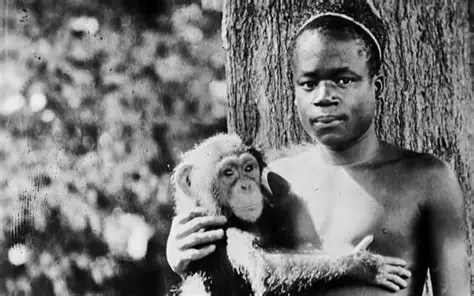
One of the most disturbing cases involved Ota Benga, who was displayed at the Bronx Zoo in 1906. He was placed in an enclosure, sometimes alongside animals, while visitors gathered to observe him. The event sparked protests from religious leaders and activists who strongly opposed the exhibition, eventually leading to his release.
Similarly, during the Paris Colonial Exhibition of 1931, millions of visitors attended displays that recreated colonial villages, where people from colonised nations were asked to perform cultural routines for public viewing.
At the time, many visitors viewed these exhibitions as educational.
But in reality, is it so??
Over the years, historians began to recognise how deeply problematic and dehumanising these displays were. What was presented as curiosity often reflected inequality, misunderstanding, and the tendency to view unfamiliar cultures through a narrow lens.
Gradually, public opinion shifted, and criticism grew louder, and by the mid-20th century, these exhibitions faded away, leaving behind a complex and uncomfortable chapter in history.
What makes this story quietly powerful is how it reveals the thin line between curiosity and compassion. The visitors who attended these exhibitions may not have seen themselves as unkind. Many believed they were learning about the world. Yet, without realising it, curiosity had transformed into something that overlooked dignity and humanity.
In our own lives, we also encounter differences, whether in cultures, beliefs, or experiences. Sometimes, unfamiliarity creates distance. Sometimes, it creates assumptions. But history reminds us that understanding begins not with observation from a distance, but with empathy and respect.
Because sometimes, the most meaningful change happens when we begin to see each other not as strangers, but as reflections of the same shared humanity.
References
Ota Benga and the Living Ethnographic Exhibit – JSTOR Daily
PS: This post is part of Blogchatter A2Z Challenge 2026
 Cerebration
Exhibiting people is a very inhuman thing to do, whatever the race or caste or anything.
LikeLiked by 1 person
Absolutely! Fortunately we abolished them but I wish even the animals were better left in the wilds
LikeLike
I am feeling uncomfortable just by the thought of Human zoos. Thankfully they are gone but you never know. Imagine how the animals must be feeling in the cages.
LikeLiked by 1 person
Yes only if we can empathize. The concept of zoos should be removed now
LikeLike
zoos per se turn my stomach. Animals are not supposed to be kept in captivity, even if it is not in a cage, but a safari. Humans as exhibits thankfully stopped, it is high time we let the animals also free
LikeLiked by 1 person
I totally agree with you. The wild animals are supposed to live in the wild and not in cages. There is nothing entertaining or educational about it. Hope the day arrives when zoos are banned
LikeLiked by 1 person
Good God! Unsettling is the word. I felt nauseous just reading this difficult but well articulated article. Thank God for those forward-thinking protesters who brought an end to such stuff.
By the way, I hate visiting zoos. I’m not an animal lover but I hate watching anything caged. Safaris in natural habitats are still okay although I feel leaving the wild alone is the best way possible
LikeLiked by 1 person
I totally agree with you. There is nothing educational about zoos. I wish the wild animals are better left in the wilds.
LikeLike
These displays were used to justify colonialism and demonstrate the supposed inferiority of non-Western cultures.
LikeLiked by 1 person
Indeed! Education was a mere excuse to satisfy their ego
LikeLike