


In 1974, a few farmers in Xi’an, China, set out to dig a well. The land was dry, and they hoped to find water beneath the surface. As their tools struck the ground, they expected rocks or soil. Instead, they uncovered something unexpected.
They found a broken piece of clay. At first, it seemed like just another fragment of pottery. But as they dug further, a life-sized head of a soldier began to emerge from the earth.
Farmers grew curious and alerted local authorities. Soon, archaeologists arrived. And what they discovered stunned the world. Beneath the soil lay an entire army.
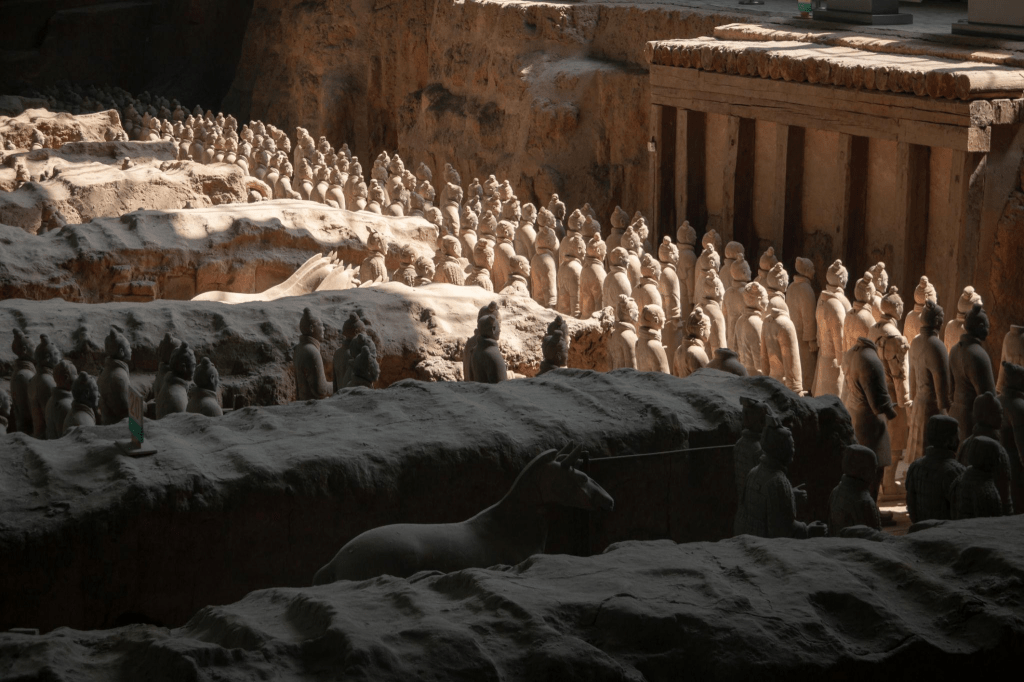
Excavations began, and soon thousands of life-sized clay soldiers were unearthed. They were standing in formation, as if ready for battle. There were rows and rows of soldiers with different expressions, hairstyles, and uniforms.
As the excavation continued, archaeologists uncovered more than 8,000 soldiers, along with horses, chariots, and weapons — all buried underground for over 2,200 years.
It seemed like another world that was frozen in time.
The Emperor Who Wanted Protection in the Afterlife
Studies revealed that the army belonged to Qin Shi Huang, the first emperor of unified China. He ruled in the 3rd century BCE and is remembered for massive projects — including the early construction of the Great Wall of China.
But what fascinated historians most was his vision for the afterlife.
Qin Shi Huang believed he would continue ruling after death. So he ordered the creation of a vast underground army to guard him.
Thousands of craftsmen worked for years.
They moulded the clay carefully, shaped individual faces with different expressions and hairstyles, and crafted weapons with precision that looked no different from the original ones.
After completion, the army, also referred to as the Terracotta Warriors, was buried near the emperor’s tomb — hidden beneath the earth.
The army stood at the centre of a complex designed to mirror the urban plan of the capital, Xianyan.
And then, over centuries, no one remembered them. Generations passed, and nature took over the ground while history quietly slept underground.
Until the farmers accidentally discovered it.
What Makes This Discovery Extraordinary
The Terracotta Army is considered one of the greatest archaeological discoveries of the 20th century.
What makes it fascinating is not just the scale — but the detail.
- Each soldier stands about 6 feet tall
- Many originally held real bronze weapons
- The army is arranged in military formation
- Some soldiers represent generals, archers, infantry, and cavalry
Even more surprising — traces of paint were found, suggesting the soldiers were once brightly colored.
Imagine an entire colourful army hidden beneath the earth for centuries.
Still Full of Mysteries
Even today, archaeologists have not fully excavated the emperor’s tomb.
Why?
Because ancient records describe rivers of mercury flowing inside the tomb, and modern studies have detected unusually high mercury levels in the surrounding soil.
To preserve the site and avoid damage, much of the area remains untouched.
Which means there may still be more waiting beneath the ground.
What fascinates me most about this story is how extraordinary things can remain hidden in ordinary places.
It was an ordinary day when the farmers dug that well. They were simply looking for water, yet it became one of the most important days in world history.
Life often works like that.
We search for one thing and discover something else entirely- hidden strengths, forgotten dreams, or unexplored possibilities.
References
https://whc.unesco.org/en/list/441/
Terracotta Army: A Complete Guide with Pictures & Infographics
Terracotta Army – World History Encyclopedia
Terra-cotta army | Qin Dynasty, Soldier, How Many, Ancient China, Discovery, & Facts | Britannica
PS: This post is part of #BlogchatterA2Z Challenge 2026
 Cerebration