

It was early morning when someone banged on the gates of the DM’s bungalow. The sound echoed through the quiet, tense air, jolting everyone awake.
A guard rushed to open it, hand on his rifle, eyes wary.
“It’s over,” the man at the gate said, breathless. His clothes were covered in dust, his face smeared with exhaustion. “The riots… they’ve been controlled.”
For a moment, no one moved. No one spoke.
It felt unreal—like a fever dream that had stretched too long, leaving them unsure of what was real anymore. Could it really be over? Was it truly safe to step out?
Word spread quickly inside the bungalow. Families stirred, whispers turning into murmurs, murmurs into hopeful conversations. Some wept silently, others clung to each other, as if afraid that if they let go, the nightmare would start again.
Mrs. Ghosh sat frozen on the floor mat, hands gripping the end of her saree. Meena, still half-asleep, looked at her mother, then around at the others. The news should have made her happy, but all she felt was an odd, heavy emptiness.
They could go home. But what was home now?
Later that morning, just as the sun had begun to chase away the cold of the night, another knock came—this time softer.
Ravi’s father rushed to the door, anticipating any further updates.
It was him.
“Baba?” Meena whispered.
Mrs. Ghosh froze in place, her breath caught in her throat. Tears welled up in her eyes, spilling over before she could even move.
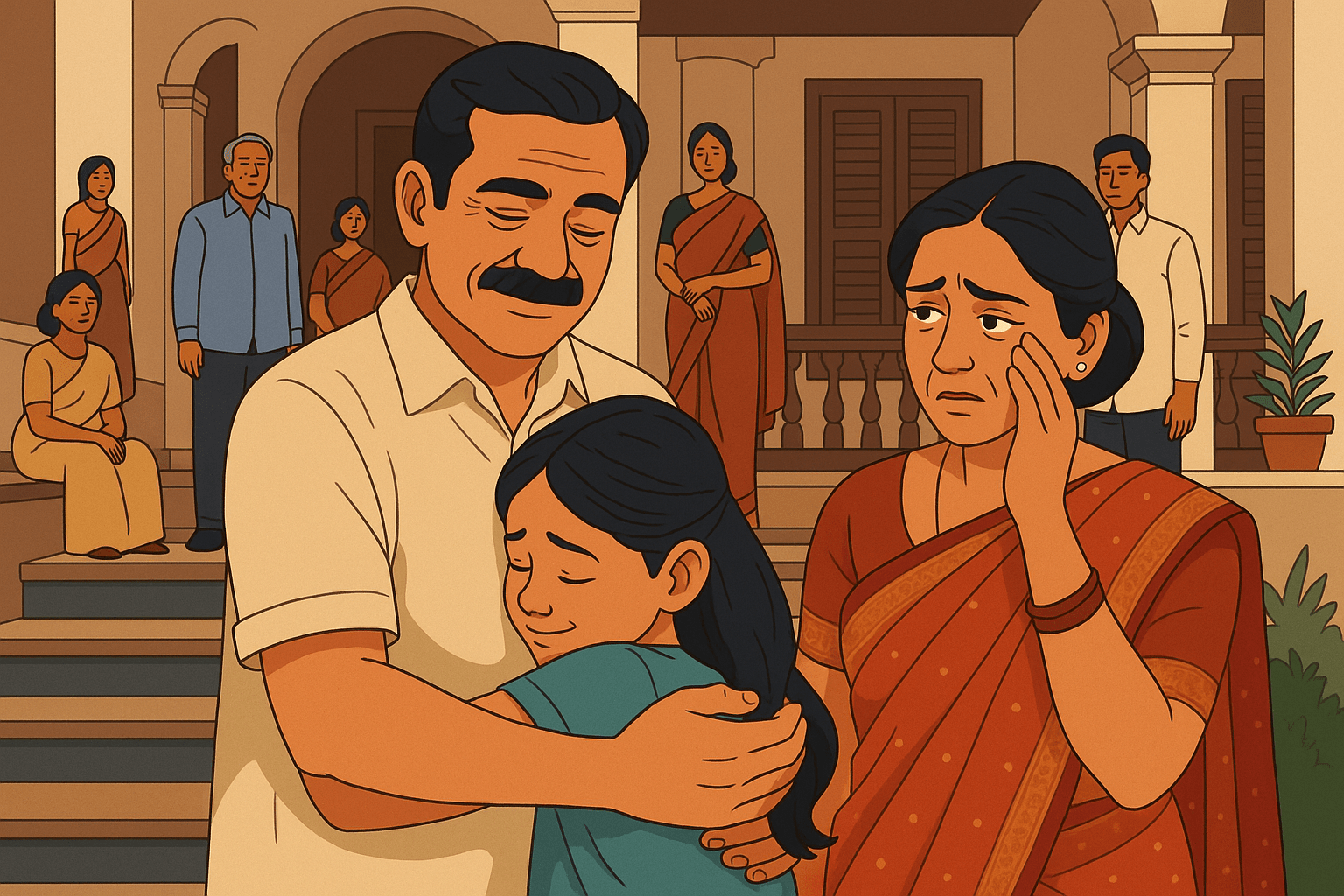
Mr. Ghosh stood at the door, looking older and wearier. A streak of dirt was on his face, his shirt wrinkled, and his eyes carried days of sleepless worry.
He opened his arms.
Meena ran into them, gripping him so tightly it hurt. She didn’t care. He was here. He was safe. That was all that mattered.
“You’re okay,” he murmured, pressing a kiss to her hair.
“You too,” she choked out, her voice barely a whisper.
Mrs. Ghosh stood rooted for a moment, overwhelmed by the sight of him. Then she rushed forward, her hands trembling as she reached out to touch his face, as though to confirm he was real.
“Where were you? What happened?” she sobbed, her voice breaking with every word.
Mr. Ghosh cupped her hands in his, his grip firm despite his exhaustion. “I’m here now,” he said softly. “I’m here.”
Mrs. Ghosh collapsed into his embrace, her tears soaking his shoulder. Meena found herself enveloped in their hug, and for a few moments, nothing else existed, just this, just them.
“I was so scared,” Meena admitted, her face buried in her father’s chest.
“I know,” he said, his voice thick with emotion. “Me too.”
The journey back was surreal.
The streets told stories of destruction—burned homes, shattered glass, walls blackened with soot and rage. Posters of missing people flapped in the wind, their curled edges whispering names no one might ever call again.
As their rickshaw turned into their lane, Meena held her breath.
Their house was still standing. Although the once-bright walls were stained with soot.
The same red gate, but hanging slightly ajar, the same mango tree, with its lower branches singed, and the same uneven steps leading up to their front door. It was as if the house was a survivor of the chaos, patiently waiting for them.
They stepped inside. The familiar scent of home—old books, wooden furniture, and her mother’s sandalwood soap- washed over Meena. But something was different.
Something was missing.
Meena was home, but the home she once knew—and the girl she once was—were nowhere to be found.
The innocence that once sparkled in Meena’s eyes, the easy laughter, the habit of speaking her heart without restraint—they were buried under layers of fear. Now, words felt dangerous, like they might ignite unseen tempers. She remained mostly silent as her voice was locked away by the fresh scar of the riots.
Days passed. Life tried to find its rhythm again, but it stumbled, like a child learning to walk after a fall. People spoke in hushed tones. Some doors never opened again.
One evening, as Meena sat on the steps outside, hugging Kassy, a cycle rickshaw stopped at their gate.
The postman.
He held out a small, slightly crumpled envelope.
Meena’s hands trembled as she took it.
The handwriting was familiar.
Kasturi.
She ripped it open, her eyes scanning the words.
“Dear Meena…..
PS: I’m participating in #BlogchatterA2Z

 Cerebration
Well, the riots are over, but I have to come ack to read what Kasturi wrote. That would be a revelation whether the friendship has survived the regional storm.
LikeLiked by 1 person
Yes it will be revealed in the subsequent chapters. You are most welcome! Thanks for taking the time to read the series.
LikeLike
Honestly, reading something in the beginning felt so much familiar that it gave me goosebumps and reminded me of something that still makes me tremble in fear, trauma, you may say. I will tell you in details someday. The line was: “It felt unreal—like a fever dream that had stretched too long, leaving them unsure of what was real anymore. Could it really be over?” This is something I often say to my mother, and to myself. Your storytelling ability is incredible. I really wish your stories are widely read by a broader audience. Much love.
LikeLiked by 1 person
Thank you for such kind words. Means a lot.
LikeLike
You may prefer to call such dreams as ‘nightmares’. Pinki, when a nightmare stays longer than it was expected, I think, people forget to dream again. The same happened with me. It feels really hard to keep myself alive from within. I am thankful to my fellow bloggers like you, who read my writings and encourage me to keep going. It’s my oxygen to keep going through all odds and challenges. Thanks for your constant support in my A to Z series. Means a lot.
LikeLiked by 1 person
Honestly, for the first time, I feel a tinge of regret that my writing resonated so deeply with a reader. I’m truly sorry that my narration brought back long-buried, unpleasant memories for you. But Swarnali, what stands out to me is your strength and resilience. Your incredible talent with words is nothing short of remarkable. And yes, I look forward to having a heartfelt conversation whenever we meet!
LikeLiked by 1 person
Nothing to be sorry, Pinki. Please don’t feel sad. You have written the truth only. Whether for me or anyone else, you will always find someone resonating with your words because your stories are deeply emotional. Keep doing the great job!
LikeLiked by 1 person
Thank you for your thoughtful words!
LikeLike
The way you depicted the eerie silence following the riots was hauntingly real—it felt like I was right there, holding my breath with Meena and her family. The moment when Mr. Ghosh returns home was so powerful; I could almost feel the relief and the weight of unspoken fears melting away in that embrace. Your portrayal of Meena’s changed perception of home was poignant; it’s heartbreaking how trauma can alter our sense of safety and belonging. The imagery of the damaged streets and the soot-stained house painted a vivid picture of a community trying to heal. The letter from Kasturi at the end was a touching reminder of the enduring bonds that can offer hope amidst despair.
LikeLiked by 2 people
Yes, after all, hope is what keeps people moving forward! Thank you for sharing your insights about the story—they’ve been truly helpful!
LikeLiked by 1 person
Good their home survived!!
LikeLiked by 1 person
😊
LikeLike
Thank you for being with the series from the beginning!!!
LikeLike
I felt a jolt. It really moved me.
You did a great job describing the journey back home, with the destruction clearly visible. I liked the this one.
It was painful to read.
Well done. All the best.
LikeLiked by 1 person
Glad to hear that you liked the chapter. Thank you for taking the time to read the series and providing such deep insights. Means a lot!
LikeLiked by 1 person
As expected, the trauma has made Meena withdraw into a shell. And amid this rollercoaster of emotions, I can image the letter from Kasturi coming as a glimmer of hope to bring back some lost joy.
LikeLiked by 1 person
Yes, the first the separation from Kasturinand then the riot. Little Meena has endured a lot. Thanks for taking the time to read!
LikeLike
i can imagine*
LikeLiked by 1 person
I’m so glad that the Ghosh family and their house is alright. Yes, of course, the emotional scars will take a while to heal and they may never come out of the trauma. But they’re okay and that’s what matters for now, right? Also happy to see the letter arriving from Kasturi. Wonder what it says though
LikeLiked by 1 person
The letter serves as a glimmer of hope for little Meena, something to look forward to. You will soon know what the letter says 🙂
LikeLiked by 1 person
This post was full of good news, the riots abating, Mr Ghosh returning, people going back to their homes and a letter from Kasturi! Dawn always follows darkness!
LikeLiked by 1 person
Indeed! Dawn always follows darkness. Thank you for investing your time and attention to the series. Means a lot.
LikeLike
This post made me smile ! First because Baba is back & second for the letter !
LikeLiked by 1 person