

20 Years Later,
New Delhi, 1991

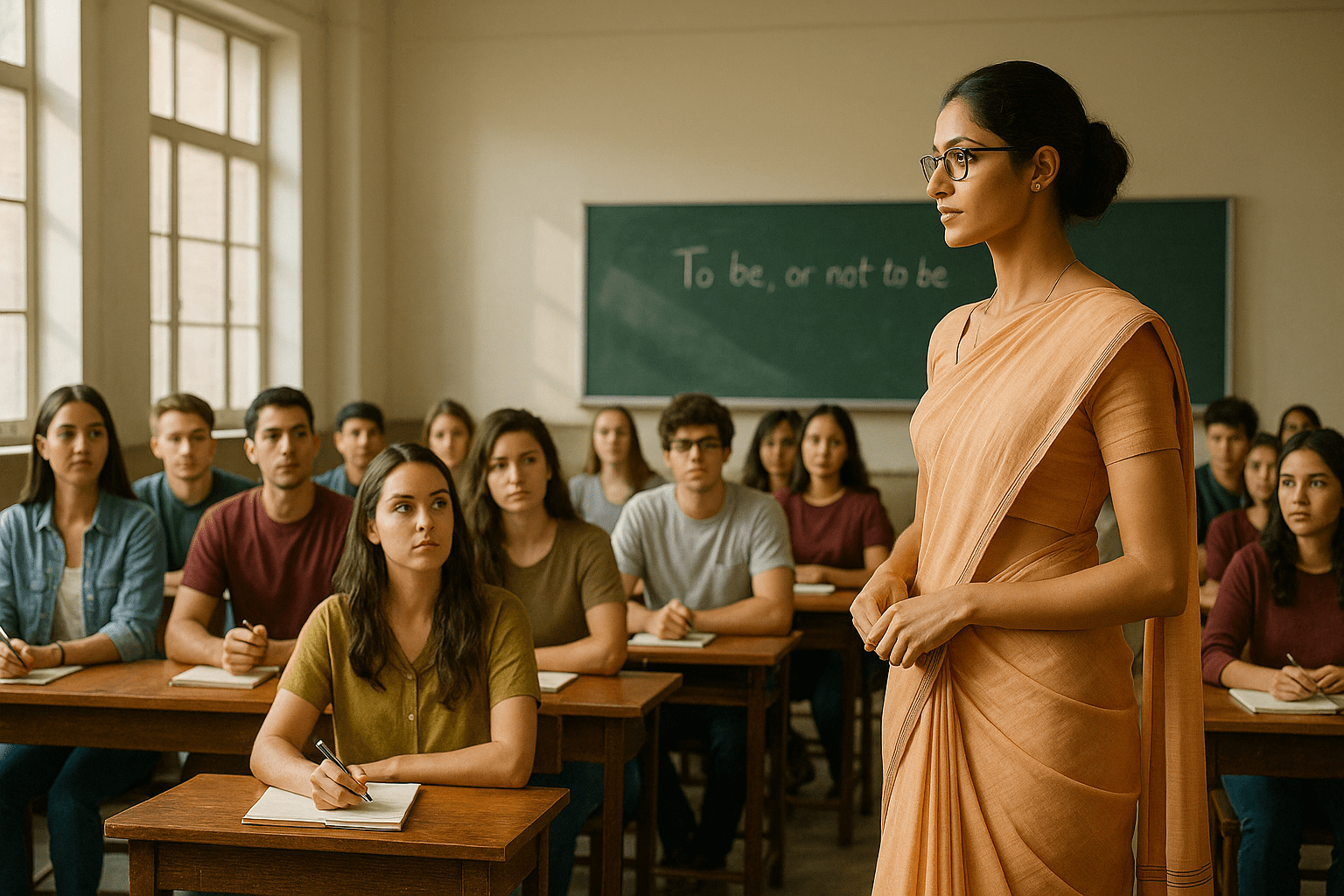
“To be or not to be… That is indeed the question,” Meena said, walking slowly across the wooden floor of the lecture hall, her voice soft yet deliberate. “But what if the question isn’t about existence, but about choice? What if Hamlet wasn’t deciding whether to live or die, but whether to act or wait?”
The room fell silent. Final-year literature students sat frozen, as if unsure whether to answer or let the question sit heavy in the air.
“Think about it,” she added, smiling slightly as the students began gathering their books. “For tomorrow, I want you to bring me a different reading of this soliloquy. Surprise me. No clichés, please.”
She stood by the door as they filed out, nodding at the regulars, making eye contact with the quiet ones. She had a way of remembering names, noticing silences, catching the pause before a question.
Outside, the Delhi sun cast long golden strokes across the JMU campus. Trees rustled with a late-autumn breeze, and a few final-year students sat under a neem tree, talking politics and poetry as if they were the same thing.
Meena adjusted her cotton peach colored saree and walked slowly down the path leading to the faculty wing. Her black hair was tied in a no-nonsense bun, and yet there was always that one stray lock she couldn’t tame. A kajal-lined gaze, thoughtful and steady, hid a world behind those glasses.
In her hands was a worn red velvet-covered diary.
She carried it everywhere. Wrote in it during lectures, between meetings, at tea stalls, even at bus stops. Her colleagues had stopped asking about it. But her close circle of friends, especially Vishal, never let it go.
Vishal had been her friend since their undergrad days—an easygoing, sharp-witted man with a kind smile and a quiet persistence. He now worked for a telecom company in Delhi, one of the new-age firms riding the early wave of technology. He didn’t understand literature much, but he understood Meena, which was enough.
One evening, as they sipped chai on the JMU rooftop terrace, Vishal pointed at the diary and asked again, “So, is this the children’s book you’ve been secretly working on?”
Meena smirked. “Not really. But it does begin with childhood days.”
He raised an eyebrow.
“It’s not a story only for the children,” she continued, looking at the sketch of a small teddy drawn in one corner of the page, “but it’s about something from childhood.”
Vishal leaned forward. “You’ve written so many books already Ms. M. Ray, Meena’s pen name, all those award-winning novels, but this, this one, you guard like a dragon.”
She laughed softly, then looked away toward the neem tree in the distance.
“It’s a memoir,” she said finally, “or something like one. I’ve written it all out. It’s with a publisher now, waiting for approval.”
Vishal didn’t push. He could tell the air had shifted.
Meena’s voice grew quieter. “I wrote it for someone. We were best friends… once. We haven’t spoken in years. But if she ever comes across it, maybe she’ll remember me.”
The wind picked up, fluttering the edge of the diary.
“Things changed after the riot,” she said suddenly, almost to herself. “I changed. I learned to be strong. But also to be quiet. I stopped trusting joy. For the longest time, I thought the world could fall apart any moment. I still do.”
She didn’t speak of the nightmares, the smell of burning houses, or the sound of her mother’s held breath in the darkness.
But Vishal heard it anyway.
He placed his tea down gently. “Meena… you never really told me what happened back then.”
She looked at him, eyes glinting behind her glasses. “I don’t talk about it. I write about it.”
And with that, she tucked the red diary under her arm and stood up.
Back to the classroom. Back to Shakespeare and Shelley. Back to a world where words tried, again and again, to heal what time had not.
But deep within her, a hope still pulsed quietly.
That one day, Kasturi might open a book, feel the tug of a familiar name, and remember a rooftop, two little girls, and a teddy named Kassy.
And maybe, just maybe, that would be enough.
PS: I’m participating in #BlogchatterA2Z

 Cerebration
So Meena is professor Meena now and also author Ms. M. Good job girl! But it seems she hasn’t healed from that childhood trauma yet. I hope this next book helps with that. Kasturi couldn’t have forgotten her, could she? Sigh!
LikeLiked by 1 person
Well, fate has laid its cards already, let’s see what’s in store for them! Thanks for staying with the story all along!
LikeLike
I missed so many episodes. good to know that Meena id doing for herself.
LikeLiked by 1 person
Thank you for stopping by!
LikeLike
You made me smile!
Reading this is heartbreaking. It reveals how deep the wound was and the lasting scar it left on little Meena’s memories.
I too have my childhood friends, who are not in contact, but the bonding between M&K is of different degree of friendship.
Hope good things happen soon.
All the best!
LikeLiked by 1 person
M&K, I like this!!!! I am glad that you liked the politics and poetry line. It’s my favourite line! Thank you for taking the time to read!
LikeLike
Meena’s quiet strength and the weight of her unspoken past are so palpable. The way she carries that red velvet diary—like a secret, a memory, a hope—is beautifully symbolic. It’s like she’s holding onto a piece of herself that the world tried to take away.
The subtlety of her relationship with Kasturi, the way it lingers in the background, adds such depth to the story. And Vishal’s gentle persistence, trying to understand without pushing, feels like the kind of friendship we all need. I love how you’ve woven in the political backdrop of 1991 Delhi—it adds a layer of realism that grounds the emotional narrative.
LikeLiked by 1 person
Yes, life moves forward, but memories have a way of lingering the longest. I’m glad you appreciated how the leap unfolded. Thank you so much for your kind words.
LikeLiked by 1 person
Not surprised at all that our dear Meena grew up to become a Writer and a Teacher! I was saddened to realize that the riots changed Meena. I hope that she and Kasturi do meet up again!
LikeLiked by 1 person
I’m glad to know that Meena growing up to become a writer and teacher didn’t surprise you. It reflects your deep understanding and connection with the characters. Thank you!
LikeLike
“But deep within her, a hope still pulsed quietly.
That one day, Kasturi might open a book, feel the tug of a familiar name, and remember a rooftop, two little girls, and a teddy named Kassy.
And maybe, just maybe, that would be enough.”
Pinki, I can’t express in words that how much it resonates with me. I wrote a short story years ago, on the same theme, with similar lines.
Maybe, I am also waiting like Meena.
LikeLike
Meena grew up to be a writer ! Wow I am just so happy. Now waiting for Kasturi to read her because I think she will.
LikeLiked by 1 person
I’m hoping both girls meet…but it should be at the right time. Maybe after her book is out…or sometime around her book launch. That would be a wonderful climax!
Cheers,
CRD
LikeLiked by 1 person
Ah! Good guess.. you will know soon 🙂
LikeLike