
“Taratari hato, Reema (Walk faster, Reema). The 11:20 local won’t wait for you.”
Baba didn’t look back. He never did. Missing a train was almost a moral failure in the Banerjee household.
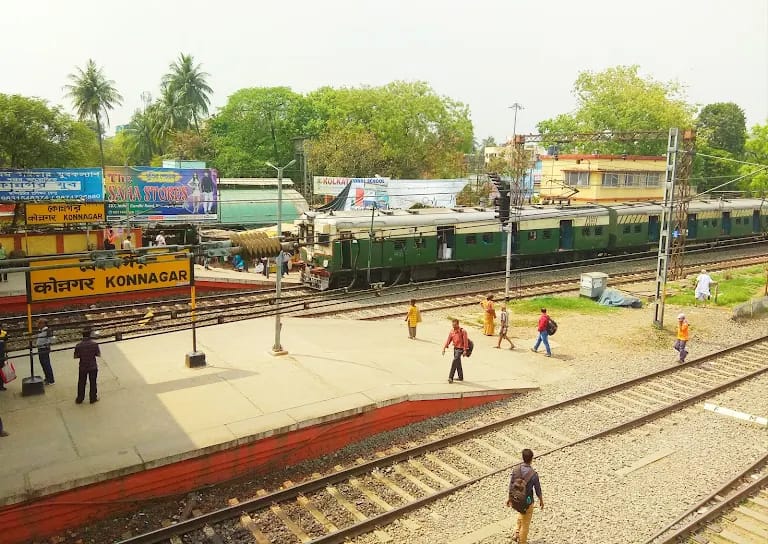
I followed him toward Konnagar station. The overbridge rose ahead- tall, grey, and mostly ignored.
Konnagar is a small town in the Hooghly district of West Bengal. My parents moved there after retirement. I live in Mumbai now, writing for a living and have come home for a short vacation.
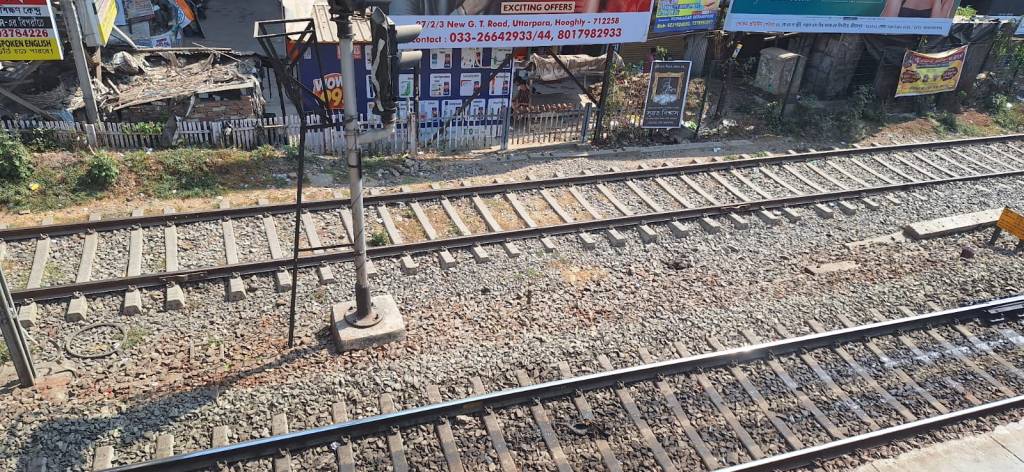
We live barely five minutes from the station. From our side of town, there is a small gap in the fence that leads straight to the platform through the tracks — a shortcut everyone knows. However, the official entrance lies on the other side of Konnagar, a long detour that few are willing to take.
As always, Baba stepped down onto the tracks.
“Baba…” I tried again, “You know this is wrong, right?”
He gave a dry laugh. “Wrong? Or practical?”
He pointed toward the bridge. “You want me to climb that with these knees? By the time I reach the top, the train will reach Howrah.”
“But what if—”
“What if nothing,” he said calmly. “We’ve been doing this for years. You just have to be careful”
I followed him anyway, heart pounding louder than the distant horn.
Every time I cross the tracks, my mind stages disasters.
What if my foot slips?
What if I trip?
What if the train doesn’t slow down?
Above us, the bridge stood like a promise of safety that is hardly used.
The next morning, the newspaper didi’s call woke me up. I picked up the local newspaper while grabbing my morning coffee.
The headline froze me.
ACCIDENT ON THE TRACKS
“Ma…” my voice trembled, “someone died last night. A 19-year old girl.”
Ma stopped stirring the tea, and baba read on in silence.
The words before me blurred.
Konnagar is small, and news spreads fast like wildfire.
Authorities were finally on alert, and by evening, metal fences had sealed the shortcut to the tracks. A large board appeared near the overbridge, and the whole week, announcements blared from an e-rickshaw moving through the streets:
“Passengers must use the overbridge. Crossing the tracks is prohibited.”
“At least now it’s safe, but…” I said softly.
But as I said it, my thoughts drifted to another looming problem.
Baba said nothing.
The next day, we reached the Konnagar station, but this time we stood at the base of the overbridge.
For the first time in years, it was crowded. Baba looked up. The stairs looked longer. Still he began climbing.
Ten steps….Pause.
“Go ahead,” he said between breaths.
“I’m not leaving you. Let’s take our own time.”
Ma, a heart patient, climbed slowly, stopping every few steps to steady her breath.
Behind us, someone muttered impatiently, “Move.”
An elderly woman clutched the railing below.
By the fifteenth step, Baba’s jaw had tightened.
“Good exercise,” he forced a smile when we reached the top.
I forced a smile too that hid both my pain and a resolve that was now beginning to take shape.
“No more bridge, baap re. Next time we will go through the main entrance and cross the tracks from there. At least that will be pain-free,” Baba said once we were seated in the local train, his smile edged with irony.
I understood. For him, risk felt lighter than pain.
That night, I wrote emails.
To the municipality.
To the railway authorities.
I wrote about the urgent need for ramps, lifts, escalators, basic dignity, and accessibility. Things Konnagar station severely lacked.
I waited for weeks, but nothing happened.
The railway blamed the municipality. The municipality blamed the railway. Files moved endlessly to nowhere.
A week later, while crossing the tracks again, Baba paused.
“Strange,” he said.
“What?”
“They woke up after someone died.”
He looked at the tracks beneath his feet.
“But they’re still sleeping while we struggle.”
I didn’t argue. Because he was right.
A few months later…
I was back in Mumbai and settled into my hectic life, but Konnagar was always on my mind.
I called Ma from the office first thing in the morning.
“Hello Ma, kemon acho (how are you)?”
“Bhalo achi (I’m good),” she replied warmly. “We read your column today. The whole town is proud of you.”
“So… any response from the authorities?”
There was a pause.
“No.”
After I hung up, I sat quietly at my desk with the newspaper open before me. The words stared back.
My words may move readers. They may stir conversations. They may even trend for a day.
But sadly the overbridge at Konnagar still has only stairs.
We wait for tragedy to enforce rules.
But we rarely design those rules with empathy.
The overbridge is finally being used.
But every day, someone still chooses between pain and risk.
We call that progress?
Some stories do not end in victory.
They end in waiting….
PS: This post is a part of ‘Echoes of Equality Blog Hop’ hosted by Manali Desai and Sukaina Majeed under #EveryConversationMatters blog hop series.
PS: This blog post is part of ‘Blogaberry Dazzle’ hosted by Cindy D’Silva and Noor Anand Chawla in collaboration with Sameeksha Reads.
 Cerebration
This is sheer ignorance and lack of inclusivity. Now after reading this blog, I understand why specially abled people find it difficult to commute in public transport. For them, it’s a herculean task.
i hope Konnagar gets an elevator some day.
LikeLiked by 1 person
Thank you for sharing your sentiments. I hope our wishes come true soon.
LikeLike
I have wondered time and again whether Indian society is inclusive at all inpractice. We have wonderful ideologies and dogmas like Tatvam Asi and Aham Brahmasmi. Vasudaiva Kudtumbakam…
In practice, we divide people into all possible categories. In the last ten years, it’s been worse than even in the old days of brutal casteism.
The physically challenged are much worse off.
LikeLiked by 1 person
I agree. We speak of high principles, yet as a society, we struggle to put them into practice. I hope someday we will learn to live by them.
LikeLike
Your post reminded me of how often we ignore the needs of those who may need ramps and railings instead of stairs. I’m sad to note that konnagar station still did not get a ramp. Obviously older people will use risk instead of safety. What choice are they given? I hope you continue to write to them…don’t give up, please!
LikeLiked by 1 person
I hope to see the change at Konnagar. Thank you for your encouragement! I
LikeLike
In the metros, there are basic amenities for the elderly and challenged people. I do see the lifts, if not ramps everywhere. But most people keep taking short cuts, jumping over the road dividing shrubs, especially on the expressways. It happens a lot near my place, suddenly someone will appear when the speed limit is 100! You can imagine how dangerous it is. Smaller towns, it’s even scarier.
LikeLiked by 1 person
That’s really sad. Even when we have access to facilities, if we behave recklessly, there isn’t much to say. Places like Konnagar are still struggling for basic amenities, but now I sometimes feel that even if they receive them, only those who truly need them will use them responsibly and not everyone.
LikeLiked by 1 person
There’s such a quiet honesty in this piece. You took an ordinary place and filled it with feeling, memory, and reflection. It lingered with me long after I finished reading. Beautifully done.
LikeLiked by 1 person
Thank you so much, Saadique!
LikeLike
As a Mumbaikar I see people taking the tracks. The first time I saw it, I was sure the man wanted to commit suicide. There are overbridges on all and escalators on many stations now but people still climb down tracks. Why? Aren’t we responsible for our safety?
Hope Konnagar gets that ramp. In a small town sometimes it may take time but authorities must be pushed for it.
LikeLiked by 1 person
Konnagar being a small town is struggling to get one unlike the slightly bigger stations over here which already have elevators. Yes, continued efforts may bring the change someday. Hoping for it!
LikeLiked by 1 person
Great to know you lived in Konnagar. I have my ties with Hindmotor, and yes I have done these crossing the track most often. Ramps are not yet there, if I am not mistaken.
LikeLiked by 1 person
Oh, that’s nice to know! Yes most of the stations here lack basic amenities but Sreerampur station however has an elevator so I am hoping the smaller stations receive the facilities sooner.
LikeLike
This post amazingly captures such a familiar part of everyday life — the overbridge, not just as a structure but as a symbol of safety, habit, and change. loved reading your post..
LikeLiked by 1 person
Thank you so much !
LikeLike
This is what I call journalist writing, to take something seemingly ordinary and create awareness among people. You’ve done it very well. These forgotten stuff like ramps, lifts, etc. need a lot of attention. We have to keep shouting until action is taken.
LikeLiked by 1 person
Thank you so much! Truly means a lot. Indeed, writing sharing and spreading the word until we see the change we hope for!
LikeLike
This is what I call journalist writing, to take something seemingly ordinary and create awareness among people. You’ve done it very well. These forgotten stuff like ramps, lifts, etc. need a lot of attention. We have to keep shouting until action is taken.
LikeLiked by 1 person
Pinki, I have already told you how much I love and admire your writing. This post touched my heart because it was about Baba. The fact that you wrote to authorities is something that has earned my respect. I hope this post reaches the right eyes and the overbridge gets a ramp. To ensure that Baba and others don’t use the tracks as a shortcut.
LikeLike
I wish Konnagar gets an elevator, ASAP.I lived in Vijayawada which is a huge junction.awe have platforms 1 to 10, maybe more now. I used to see how my dad used to leave for the station more than an hour in advance, as the train to Delhi was always on platform 8 and the overbridge was a tough climb. WE did get an escalator later but I never got on to it. I saw a lady in a saree, hurting herself very badly, when her saree got stuck in the not so smooth escalator.As you said, in India there is reaction only after loss of life.
LikeLike
I really hope authorities wake up and do something that eases climbing up foor elders. Loved your writing style
LikeLike
This is a sorry state of our public administration. Files are stuck in red tape, you are asked to come back again and again on the next Monday for years, before you can see even a slight hope of your work being done. People are getting cynical about administration day by day/.
LikeLike
We wait for tragedy to enforce rules
Perhaps the defining roadblock to most solutions for our problems today. Sigh!
LikeLike
We as a nation are terriby unfriendly to seniors, disabled. If there are elevators they are used by youngsters, even while seniors are forced to walk
LikeLike
Most of the time we stand up for so many causes so that the people who need it the most benefit from it. Nice post that shows Empathy in action.
LikeLiked by 1 person
Thank you. I hope the purpose of writing this piece gets fulfilled someday sooner
LikeLike
I remember a few years ago there was a move towards consciously designing inclusive spaces but i don’t know where those plans have gone. it is difficult got the people but it is the responsibility also of the people to raise their voices for better and safer design which is inclusive to all people and abilities.
LikeLike
This story hit me deeply. I could feel the tension, the love, and the quiet frustration. Your writing made me care and reflect profoundly.
LikeLiked by 1 person
Thank you!
LikeLike
Reading it, I could feel that mix of nostalgia, routine, and the quiet danger that comes with shortcuts we take without thinking. I’ve seen similar things in my own hometown, and it’s scary how quickly something so normal can turn tragic. Perfectly penned.
LikeLiked by 1 person
Thank you, Anjali!
LikeLike
accessbility remains a huge problem for the physically disabled even in 2026. they have accepted that nothing will change though.
LikeLiked by 1 person
It’s a shame that even today we have to fight for inclusivity and that people have already given up the hope. May things change for better, someday!
LikeLike
Your post left me with many emotions – sadness, frustration, anger. If our public bodies just focused on their jobs and responsibilities – we would be a much better country.
LikeLiked by 1 person
Alas! Only if they did. I get your feelings. Thanks for stopping by!
LikeLike
I just love your writing Pinki! And the way you have used Bengali sentences, I really like it!
LikeLiked by 1 person
Thank you so much, Mandira!
LikeLike