

On September 12, 1940, four teenage boys in the village of Montignac, in Southwestern France, followed their dog into the woods. It was an ordinary afternoon just like any other day. Their dog had disappeared into a narrow hole in the ground.
As the boys widened the opening and climbed inside, they expected to find a tunnel or perhaps an old shelter. Instead, they found something astonishing.
The walls were covered in paintings. The paintings were neither recent nor medieval.
Later, it was found out that the paintings were created over 17,000 years ago.
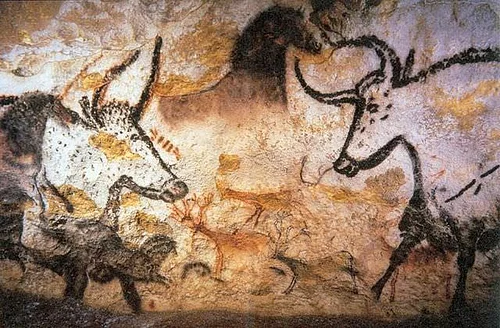
Animals stretched across the cave walls — horses, deer, bulls, and typical local contemporary fauna. The figures seemed alive, as if moving across the stone.
The boys had accidentally discovered the Lascaux Cave Paintings, one of the most important prehistoric discoveries in the world, which was inducted into the UNESCO World Heritage List in 1979.
A Gallery From the Stone Age
The cave walls revealed hundreds of paintings. There were large bulls painted with precision, horses galloping across rock surfaces, and deer drawn in motion.
What fascinated researchers most was the sophistication. These were not rough sketches.
The artists had used:
- Natural pigments from minerals
- Charcoal and ochre
- Shading techniques
- Perspective and movement
Some paintings were created high on cave ceilings, meaning early humans likely used ladders or scaffolding. This discovery changed how we viewed early humans.
They were not just survivors. They were thinkers, observers, and artists.
A Silent Message From the Past
These early humans cared about expression. They observed animals closely. They told stories through art.
Some researchers believe the caves may have been used for rituals or spiritual practices. Others think they were early storytelling spaces.
We may never know for certain. But what we do know is that creativity existed long before civilization as we know it.
Protecting the Discovery
After the caves were opened to the public, thousands of visitors came to see the paintings.
But something unexpected happened. The breath of visitors, combined with light and humidity, began damaging the artwork. Slowly, the paintings started fading.
To preserve them, authorities made a difficult decision — they closed the original caves to the public in 1963.
Today, replicas allow visitors to experience the beauty without harming the original.
What fascinates me most about this story is the quiet continuity of humanity.
Seventeen thousand years ago, someone stood in a dim cave, held natural pigments and painted what they saw.
They may not have imagined that thousands of years later, someone else would stand in the same space, looking at their work with wonder.
It reminds us that human expression connects us across time.
We may live in different eras, use different tools, and speak different languages.
Yet the desire to create remains the same.
Sometimes, we think creativity requires perfect conditions.
But the Lascaux artists painted in caves with limited resources and simple tools.
What they had was imagination.
Perhaps the lesson is simple. You don’t need perfect conditions to create something meaningful. You just need curiosity and the courage to leave your mark.
And somewhere, years from now, something we create today may become a whisper from history.
References:
- UNESCO World Heritage — Lascaux Cave Paintings
https://whc.unesco.org/en/list/85/ - Lascaux – Wikipedia
- Lascaux Cave – World History Encyclopedia
- Lascaux | Definition, History, & Facts | Britannica
PS: The post is part of #BlogchatterA2Z Challenge 2026.
 Cerebration
Beautifully said about human connection, Pinki! Seems like it’s a thing everywhere. Any new discovery attracts so much attention that people ending almost destroying it!
LikeLike
We may live in different eras, use different tools, and speak different languages.
Yet the desire to create remains the same.
And I’m so glad we belong to this group. In our own way, through our content we too are leaving behind something, however miniscule. 🙂
LikeLike